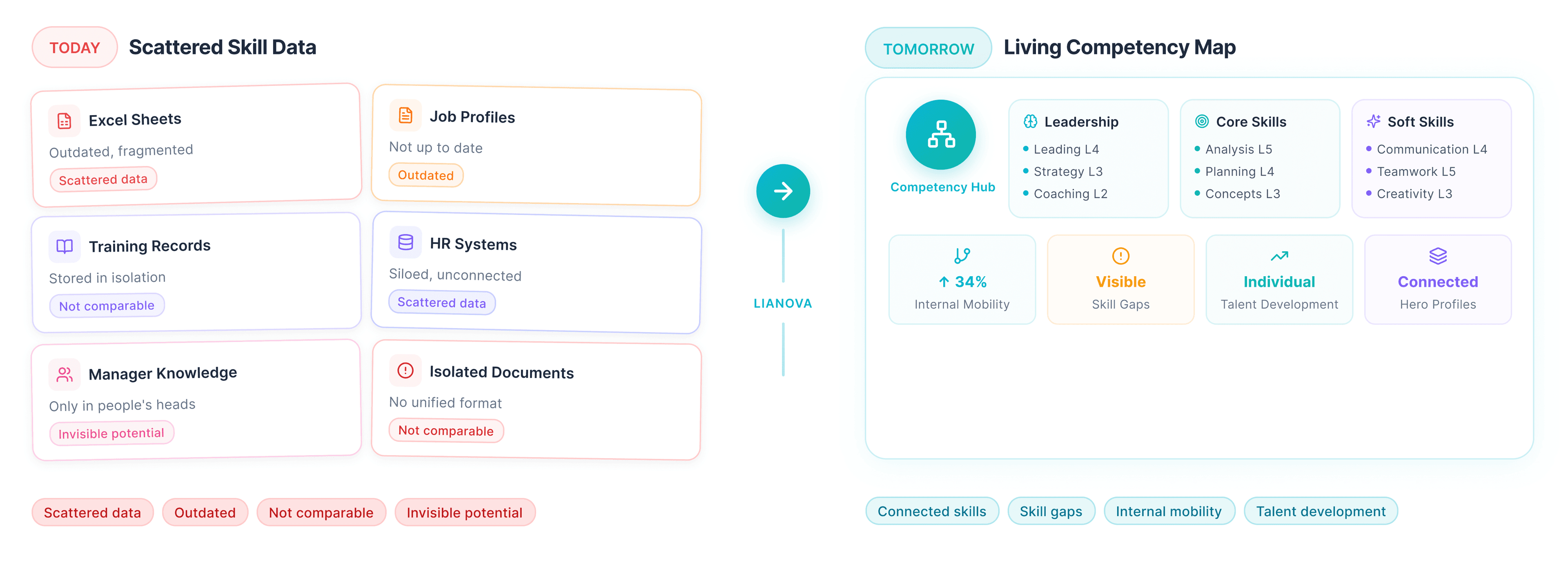
Many companies believe they already have skills management in place. In reality, they have Excel sheets, job profiles, training histories and the experience-based knowledge of individual managers. Somewhere in the company, there might be a list showing who attended which training. Somewhere, a team lead might know who is especially strong in customer communication. Somewhere, there may be a competency file that was last updated three years ago.
The problem is that this information is rarely up to date, hardly comparable and often not usable enough to support better decisions.
This is where modern skills management begins. It is not about filling yet another database with skill terms. It is about making competencies visible in a way that helps organizations deploy, develop and retain people more effectively. Scattered information needs to become a living competency map.
Why skills management is becoming increasingly important for companies
Skills management is becoming a key success factor for companies. Organizations are changing faster, tasks are shifting, projects are emerging at shorter notice and traditional job profiles are increasingly unable to reflect the reality of everyday work.
In the past, companies could plan more strongly around positions, departments and fixed career paths. Today, that is no longer enough. A role can change within a few months. New technologies create new requirements. Teams need new forms of collaboration. At the same time, finding suitable people externally is becoming increasingly difficult.
Organizations are changing faster than their job profiles
Job profiles are often snapshots. They describe which tasks, requirements and qualifications are considered relevant at a certain point in time. But in dynamic organizations, requirements are constantly changing.
New projects emerge, customer expectations shift, processes become automated and teams work in more interdisciplinary ways. As a result, it is no longer enough to look at people only through job titles or formal qualifications.
A project manager is not simply a project manager. What matters is which methodological competencies are present, how well communication across interfaces works, whether analytical skills are strong and which experiences have already been gathered in complex transformation contexts.
Skills management helps make this level visible.
Skills become the basis for strategic decisions
When companies know which competencies are available, they can make more strategic decisions. They can identify more quickly which capabilities are available for new projects, where external recruitment is necessary and which competencies can be built internally.
This makes skills management a foundation for workforce planning. It does not only answer the question of how many people an organization needs, but which capabilities these people need to bring.
Especially in times of skills shortages, transformation and increasing efficiency pressure, this distinction becomes critical. Organizations do not only need to fill positions. They need to make better use of existing potential.
HR needs transparency instead of gut feeling
Many HR decisions are still based on incomplete information. Managers recommend employees they already know well. Development opportunities are offered to those who are visible. Internal roles are advertised externally, even though suitable potential may already exist within the company.
This is rarely intentional. In many cases, the data basis is simply missing.
Skills management creates transparency. It makes visible which competencies, experiences and development potential already exist within the organization. This enables HR, managers and employees to make better-informed decisions.
The problem: Skill data is everywhere, but rarely useful
In many companies, there is more skill data than it seems at first glance. The problem is not always a lack of data. More often, the real problem is a lack of structure.
Skill information can be found in CVs, job profiles, employee conversations, training lists, project documents, feedback processes, HR systems and in the minds of managers. Some data is formally documented. Other information emerges informally in day-to-day work. Some competencies are never captured at all, even though they would be highly valuable for the organization.
Excel sheets show data, but not real decision-making power
Excel is the hidden standard for skills management in many organizations. Skills, certificates, training records and assessments are collected there. For an initial overview, this can be useful. For strategic decisions, it is not enough.
Excel sheets are static. They become outdated quickly. They rarely show how confidently a competency is actually available. They hardly distinguish between interest, experience, application confidence and true excellence.
In addition, the data often remains isolated. One list sits in HR, another in the business unit, a competency catalogue sits in people development and additional information is hidden in employee conversations. This does not create a shared competency logic. It creates a patchwork.
Modern skills management needs to bring this information together, structure it and make it usable.
Manager knowledge often remains invisible
In many organizations, managers know a great deal about their employees. They know who communicates well with customers, who can moderate conflict, who remains stable in crises or who quickly understands complex topics.
This knowledge is valuable, but often not systematically available. It remains tied to individual people. When managers change, context is lost. When decisions need to be made across departments, this knowledge is hardly accessible.
This creates a risk: organizations only use the potential that happens to be visible.
Skills management must therefore not be limited to formal information. It also needs to make experience-based knowledge systematically accessible, without reducing people to subjective ratings.
Informal competencies fall through the cracks
A particularly large blind spot lies in informal competencies. Many capabilities do not emerge in seminars or formal education pathways, but in real life.
Someone who organizes voluntary work may develop leadership, communication and problem-solving skills. Someone who cares for relatives may develop resilience, responsibility and prioritization skills. Someone who has navigated migration experience may have built adaptability, intercultural competence and resilience.
These competencies are often highly relevant for organizations. Nevertheless, they rarely appear in traditional skill databases.
If skills management only captures formal qualifications, a large part of human competence remains invisible. As a result, companies lose valuable potential.
Why traditional competency management is often too static
Many companies have already developed competency models. In principle, this is useful. A competency model creates language, structure and orientation. But traditional competency management often fails because it remains too static.
Once competency catalogues have been defined, they are rarely maintained continuously. Terms are not always clear. Different departments use different skill logics. Managers assess competencies subjectively. Employees are not always sure how to classify themselves. And HR faces the challenge of turning many inconsistent inputs into a reliable overall picture.
Competency models age faster than organizations think
At the moment of introduction, a competency model often looks very clean. It includes defined competency areas, descriptions, rating levels and sometimes also target profiles for roles.
But organizations change. New technologies emerge. Business models evolve. Teams work differently. Roles shift. As a result, a competency model ages faster than many companies expect.
If maintaining the model becomes too time-consuming, it is used less and less. In the end, it may still exist formally, but it has little impact on actual decisions.
Modern skills management therefore needs to be more dynamic. It requires structures that can evolve together with the organization.
Different terms prevent comparability
Another problem arises from inconsistent language. One department talks about project management, another about delivery management, a third about agile coordination. Sometimes they mean something similar. Sometimes there are important differences.
Without a shared skill language, competencies become difficult to compare. HR cannot clearly identify which capabilities are actually available. Managers cannot formulate requirements consistently. Employees do not know how to classify their competencies.
A living competency map therefore needs a clear taxonomy. It must structure skills, competencies, competency areas and requirements in a way that both people and systems can work with.
Assessments often remain subjective
Competency assessments are often strongly dependent on context. One manager rates strictly, another generously. Employees may overestimate or underestimate themselves. Some competencies become visible, while others remain hidden.
This does not mean that subjective assessments are worthless. On the contrary, self-perception, external feedback and the manager perspective can provide valuable information. But they need to be brought together in a structured way.
Good skills management should therefore integrate multiple perspectives. Self-assessments, experiences, feedback, project context and requirements together create a much more reliable picture than a single rating.
What modern skills management needs to deliver
Modern skills management needs to do more than capture skills. It needs to place competencies into a meaningful context.
This includes timeliness, comparability, context and actionability. A competency map is not the end goal. It is the basis for better decisions in recruiting, talent management, internal mobility, project staffing and organizational development.
Skill data must be current and dynamic
Skill data quickly loses value if it is not maintained. A capability that was relevant years ago may no longer be actively used today. At the same time, employees build new competencies in their daily work without those competencies ever being documented.
That is why skills management needs continuous updating. This does not mean that employees need to fill out long questionnaires all the time. Rather, it requires intelligent processes that allow experiences, developments and new requirements to continuously flow into the competency map.
This is how skills management stays alive.
Competencies need context
A competency is more than a term. What matters is where it comes from, how strongly it is developed, how reliable the assessment is and in which context it has been applied.
The statement “communication skills available” only helps to a limited extent. It is much more valuable to know that someone can translate complex technical topics for non-technical stakeholders, has already moderated conflict situations and is perceived by colleagues as a connecting force.
Context makes competencies interpretable. Without context, skills management remains superficial.
Skills management must enable decisions
The most important question is not: Do we have a skill database?
The more important question is: Can we make better decisions with it?
Good skills management supports concrete decisions. Who fits a project? Who could take over a critical role? Which competencies are missing in a team? Which employees have potential for a development path? Which skill gaps threaten the strategy?
If skill data is not translated into decisions, skills management remains administrative. Impact only emerges through real use cases.
People must not become skill containers
Despite all data logic, one point is essential: people are not collections of skill tags.
Competencies emerge from experiences, motivation, personality, working style and context. If skills management is understood too mechanically, people are reduced to keywords. This can damage acceptance and lead to poor decisions.
Modern skills management must therefore be both data-driven and human. It should make visible what people can contribute without losing their complexity.
The competency map as the heart of modern HR work
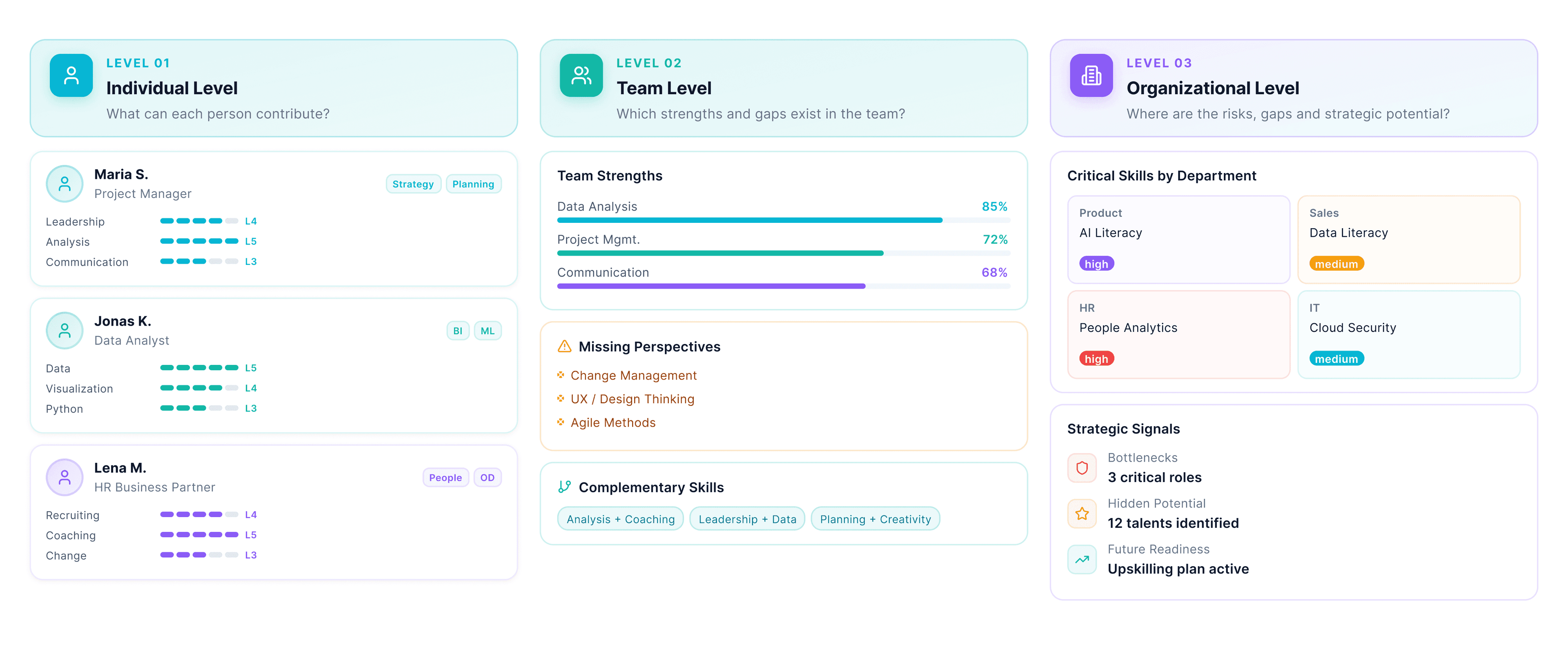
A competency map is more than an overview of available skills. It shows how capabilities are distributed across the company, where strengths are located and where gaps are emerging.
At the individual level, it makes visible which competencies a person brings. At the team level, it shows which capabilities are available and which perspectives are missing. At the organizational level, it creates a strategic picture: Where are critical competencies located? Which skills are only available in a small number of people? Which areas depend heavily on individual knowledge holders? Where are development needs emerging?
Making competencies visible at the individual level
For employees, a competency map can be highly valuable. It does not only show what they currently do, but also which capabilities they have already built. This creates a more differentiated picture of their own development.
People with non-linear CVs benefit especially from this. Their competencies become visible not only through formal stations, but through experiences, tasks, projects and personal development.
This strengthens orientation and self-efficacy. Employees can see which strengths they can contribute and which development steps are realistic.
Identifying skill gaps in teams
At the team level, it becomes visible which competencies are available and which are missing. A team may be technically strong, but have methodological gaps in project steering. Another team may have strong execution power, but lack strategic or communicative bridging skills.
Such insights are highly valuable for leadership and team development. They help build teams not only based on availability, but based on strengths, gaps and fit.
A competency map therefore does not only show deficits. It also shows which combinations of people can be especially effective.
Understanding organizational risks and potential
At the organizational level, skills management becomes strategic. Companies can identify which competencies are critical, where dependencies exist and which potential remains unused.
If an important technology is mastered by only two people, this creates risk. If several employees show hidden leadership competencies, this creates talent potential. If a department barely covers certain future skills, this creates development needs.
A living competency map makes these patterns visible. This makes HR more relevant for strategic business decisions.
From life stories to skills: Why experience shows more than CVs
A central problem of traditional skill capture is that it often only considers formal stations. Education, degrees, job titles, certificates and training are relatively easy to capture. But they only show part of what people can actually do.
Many relevant competencies emerge outside linear career paths. For skills management, this perspective is crucial. If organizations only look at formal qualifications, they overlook potential. But if they systematically capture experiences and translate them into competencies, a much more complete picture emerges.
Formal qualifications only show part of competence
CVs are useful, but limited. They show stations, degrees and functions. But they rarely show which experiences shaped people, which problems they solved and which capabilities emerged from those experiences.
Two people with the same job title can have built completely different competencies. One person may have mainly stabilized processes. Another may have resolved conflicts, built teams or introduced new structures.
Skills management needs to make these differences visible. Otherwise, competency profiles remain too broad.
Biographical experiences create valuable capabilities
Biographical experiences can be powerful sources of competence. Crises, detours, responsibility, migration, voluntary work, family work or personal new beginnings create capabilities that organizations urgently need.
These include resilience, perspective-taking, communication skills, responsibility, learning ability, cultural sensitivity and self-organization.
These capabilities are not less valuable because they do not appear on a certificate. On the contrary, they are often particularly stable because they emerged from real experience.
Modern competency analysis needs a broader view
Modern competency analysis must therefore take a broader approach. It should consider formal qualifications, but not stop there.
The decisive question is: Which experiences have created which capabilities?
When organizations understand this connection, a new perspective on people emerges. It is not the perfect CV that matters, but the fit between experience, competence, potential and organizational need.
How Lianova makes skills management come alive
Lianova starts exactly at this point. The platform does not treat skills management as a static database, but as a living process.
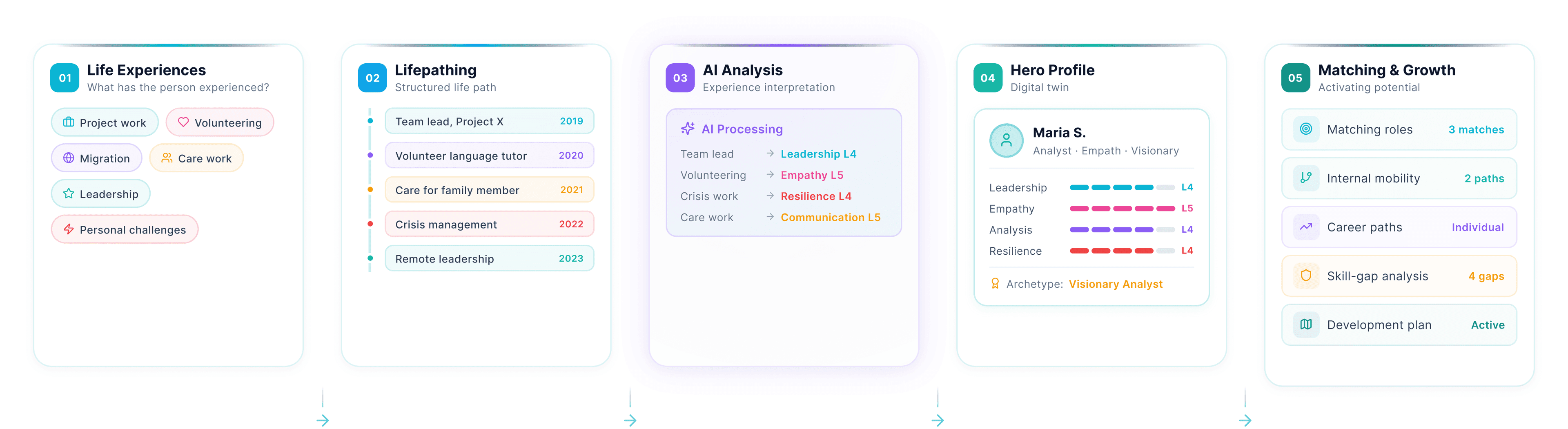
At the center is the Herofication approach. Employees are not reduced to job titles or formal qualifications. Instead, a digital Hero profile is created, making competencies, experiences, personality aspects and development potential visible in a structured way.
Lifepathing translates experiences into competency data
An important building block is Lifepathing. People describe formative experiences, stations and events from their lives. These experiences are transformed into so-called LifeBubbles and then analyzed with the help of AI.
The result is a competency profile that considers not only formal skills, but also capabilities from real experiences. This makes visible what often remains hidden in traditional CVs, job profiles or HR data.
Lifepathing makes skills management more personal and at the same time more structured. People do not merely describe what they have done. The system helps translate these experiences into usable competency information.
Digital Hero profiles create comparability
The analyzed experiences are transformed into digital Hero profiles. These profiles bundle competencies, experiences and other relevant characteristics in a form that organizations can use.
This creates comparability without making people the same. Each person remains individual, but their competencies become visible within a shared structure.
For HR and managers, this creates a new basis for decision-making. They no longer see only job titles or departments, but competency profiles, potential and possible fit with roles, projects or development paths.
Four competency areas provide orientation
To prevent skills management from becoming confusing, it needs a clear structure. Lianova works with strategic competency areas that make different capability dimensions visible.
These include professional competencies, methodological competencies, social or interpersonal competencies and personal or intrapersonal competencies.
This structure helps ensure that competencies are not treated merely as isolated keywords. It shows whether a person primarily brings professional expertise, methodological strength, social effectiveness or personal resources. For talent management, project staffing and development, this differentiation is crucial.
Matching connects people with roles, projects and development paths
The real value of skills management emerges in matching. When competency profiles are connected with requirements, it becomes visible which people fit which roles, projects or development paths.
This is not only about the perfect current-state match. The analysis of skill gaps is especially valuable. It shows which competencies are missing and how realistic development toward a certain role would be.
This turns a competency map into an active steering instrument. Organizations do not only recognize what is available. They also see how competencies can be set in motion.
Skills management and internal mobility
One particularly important use case for skills management is internal mobility. Many companies search for new employees externally, even though people may already exist internally who could move into new tasks with targeted development.
The problem is often not a lack of potential, but a lack of visibility.
Internal talent remains invisible without skill transparency
If competencies are not transparent, internal talent remains invisible. Managers think of the people they already know. HR searches externally because there is no reliable internal data basis. Employees leave the company because they do not see development perspectives.
This is costly for organizations and frustrating for employees.
Skills management creates the foundation for systematically identifying internal potential. It shows who already brings relevant competencies, who could develop and which people may be suitable for new tasks.
Skill gaps show realistic development paths
Internal mobility does not mean that people need to fit a role perfectly right away. Often, it is enough if the foundation is present and missing competencies can be developed in a targeted way.
Skill gap analyses make exactly this visible. They show which capabilities are missing for a role, how large the gap is and which development steps would be useful.
This makes career paths more concrete. Employees see what they need for the next step. Managers can support development more effectively. HR can enable internal movement more systematically.
Internal mobility reduces dependence on the external labor market
External recruitment remains important. But companies that only look outside often overlook their own potential.
Internal mobility can shorten time-to-fill, reduce recruiting costs and strengthen retention. Above all, it shows employees that development within the company is possible.
Skills management therefore becomes an instrument against fluctuation. People are more likely to stay when they see that their competencies are recognized and that they have future perspectives within the organization.
Skills management and talent development
People development also changes fundamentally through skills management.
Traditional people development often works from the available offer. There are trainings, programs and development catalogues. Employees or managers select what seems suitable. This can be useful, but it often remains insufficiently connected to concrete organizational requirements.
Development begins with real competency data
Skills management enables a different logic. Development does not begin with a training offer, but with a competency map.
Which competencies are available? Which are missing? Which roles are becoming more important? Which people have potential for certain development paths? Which skill gaps need to be closed to enable internal mobility?
These questions make people development more strategic. Development is no longer planned separately from organizational need, but derived from real competency data.
People development becomes more individual and measurable
When competency data is visible, development can be designed more individually. Not all employees need the same training. Not every team has the same gaps. Not every career leads into leadership.
Skills management enables differentiated development paths. One person may need methodological support, another professional deepening, a third social or communicative development.
At the same time, people development becomes more measurable. Organizations can assess whether development measures actually contribute to relevant skill gaps.
Career paths become visible and manageable
Many companies talk about career paths, but they often remain abstract. Employees do not know exactly which competencies they need for the next step. Managers can only justify development to a limited extent. HR struggles to design career paths systematically.
Skills management creates orientation. It connects current competency profiles with target roles and development paths. This makes visible which steps are realistic and which competencies need to be built.
Career becomes less random and more manageable.
Skills management needs more than technology
Despite the importance of digital systems, one point must not be overlooked: skills management is not only a technology project.
Of course, it requires good data, a meaningful platform and intelligent analysis functions. But success depends just as much on culture, acceptance and communication. Employees need to understand why their competencies are being captured. Managers need to learn how to use skill data responsibly. HR must ensure that the competency map does not become a control mechanism, but a foundation for development.
Acceptance comes from transparency
People need to understand what happens to their data. Which competencies become visible? Who can see which information? What is the data used for? Which decisions are derived from it?
Without transparency, mistrust emerges. Skills management is then perceived as an evaluation system, not as a development instrument.
That is why clear communication is essential. Employees should understand that competency transparency can open up new perspectives for them. Development, not control, must be at the center.
Managers must use skill data responsibly
Managers play a central role. They need to learn not to treat skill data as absolute truth, but as a decision-making basis.
A competency profile can provide indications, but it does not replace the conversation. A skill gap analysis can show development opportunities, but it does not decide about people on its own. Matching can make fit visible, but it always requires context and responsibility.
Good skills management connects data with leadership competence.
The competency map must not become a control instrument
A competency map can only be effective if it is experienced as a helpful tool. If employees feel that their profiles are being used against them, their willingness to participate honestly will decline.
That is why the purpose must be clear: skills management should make potential visible, enable development and create better fit.
It should not reduce people to deficits. It should make capabilities visible and bring them meaningfully into motion.
Conclusion: Skills management needs a living competency map
Skills management is more than the administration of skill terms. It is the foundation for intelligently connecting people, competencies and organizational requirements.
Excel sheets, static competency models and isolated HR data are not enough. They often only create a snapshot. Modern organizations need a system that continuously makes competencies visible, updates them, contextualizes them and makes them usable for decisions.
From static data to strategic agility
A living competency map shows what people can really do. It makes potential visible that remains hidden in traditional CVs, job profiles or training histories. It supports talent management, internal mobility, workforce planning, project staffing and targeted people development.
This turns skills management into a strategic instrument. Organizations can react faster, develop more effectively and deploy existing capabilities more intentionally.
Lianova as the foundation for living skills management
Lianova creates exactly this foundation. Through Lifepathing, digital Hero profiles, AI-supported competency mapping and intelligent matching logic, skills management evolves from an administrative data problem into a strategic development instrument.
Because the key question of the future is not only: Which positions do we have?
The more important question is: Which competencies do we already have, and how can we bring them into motion?
FAQ
What does skills management mean?
Skills management describes the systematic capture, structuring, updating and use of competencies within an organization. The goal is to make visible which capabilities exist, which are missing and how people can be deployed or developed in a more targeted way.
Why are Excel sheets not enough for skills management?
Excel sheets are often static, inconsistent and difficult to keep up to date. They usually show individual skill terms, but not the context, level, timeliness or development potential of a competency.
What is a competency map?
A competency map shows which competencies are available in an organization and how they are distributed across people, teams, roles or projects. It helps identify skill gaps, strengths, development potential and internal mobility options.
How does Lianova support skills management?
Lianova translates experiences, competencies and personality aspects into digital Hero profiles. Through Lifepathing, AI-supported competency mapping and matching, a living competency map emerges that can be used for talent management, internal mobility and workforce planning.
What role does skills management play in internal mobility?
Skills management makes visible which employees may be suitable for new roles, projects or development paths. This helps companies make better use of internal talent, support development more specifically and reduce external recruiting costs.