
Burnout-Prevention should not start with sick leave, conflict or resignation. HR and leaders can act earlier by making psychological strain, workload, leadership signals and development barriers visible in everyday talent decisions. Individual resilience helps, but it cannot compensate for chronic overload, unclear priorities or a culture that rewards constant availability.
Where Burnout-Prevention starts
Burnout-Prevention begins in the systems that decide who carries critical work, how priorities are negotiated, whether leaders notice overload and how safely people can speak about strain. It is less a wellbeing campaign than a question of work design, leadership and organizational culture.
In talent management, this changes the core question. HR should not only ask which people show potential, but also under which working conditions that potential can stay healthy. A high performer who repeatedly absorbs unclear priorities may look reliable for a while. Over time, the same pattern can block learning, reduce motivation and increase the risk of leaving.
Burnout is rarely caused by one difficult project. The more relevant pattern is chronic workplace stress that has not been successfully managed: high workload, low control, unclear expectations, weak recognition, unresolved conflict and too little recovery. The WHO describes burnout in ICD-11 as an occupational phenomenon, not as a personal weakness.
For a broader cultural view, the article on mental health in the workplace is a useful next step.
Strain quietly blocks growth
Talent development needs energy, attention and a sense of future. When people are permanently overloaded, development becomes one more demand on top of delivery pressure. Learning goals are postponed, internal moves feel risky and employees avoid responsibility because the current role already consumes too much capacity.
This is why burnout prevention belongs close to succession planning, career paths, leadership development and employee experience work. A talent portfolio that measures performance but ignores psychological strain is incomplete. It may identify the people the organization depends on while missing the conditions that put those people at risk.
The same logic applies to employee retention. People rarely leave because of one hard week. They leave when the organization keeps asking for more while giving too little clarity, autonomy, recognition or recovery.
Career architecture can help when it makes development paths transparent instead of pushing every strong contributor toward more overload. For that angle, see this practical guide to designing career paths in organisations.
Warning signs appear in patterns
Burnout risks are not always obvious. Some employees remain outwardly engaged for a long time, take on additional tasks and meet expectations even after their personal stress limit has been crossed. HR and leaders therefore need a combined view of behavior, team climate and work context.
Useful signals include changed communication, withdrawal, irritability, concentration problems, declining quality, frequent overtime and a visible loss of initiative. At team level, meeting fatigue, conflict escalation, cynicism, silo behavior or rising turnover intention can point to deeper strain.
In Germany, the assessment of psychological strain is part of occupational health and safety. It does not diagnose individuals. It helps organizations make structural stress factors visible, such as work intensity, autonomy, social support and leadership behavior.
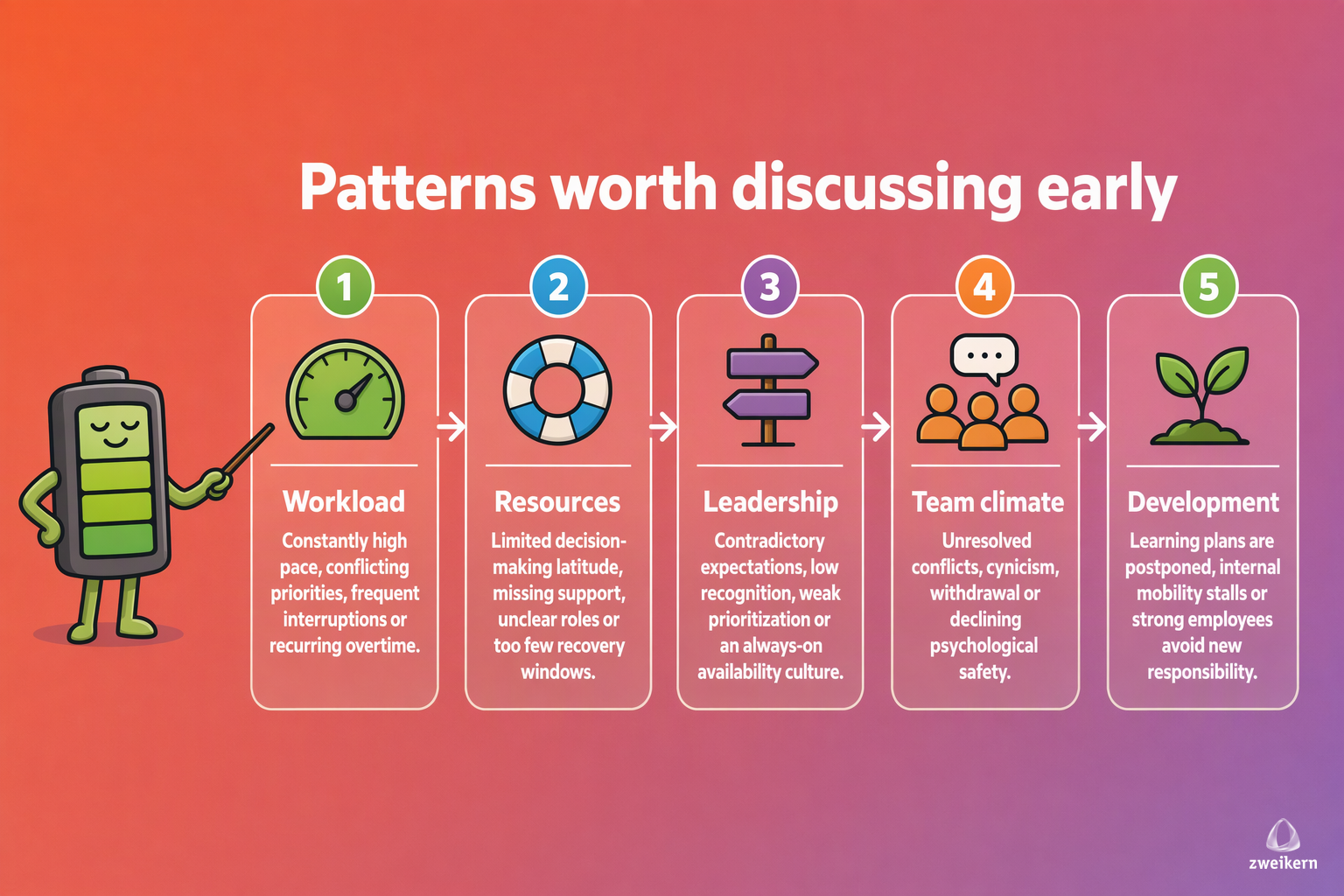
Patterns worth discussing early
The aim is not to turn managers into therapists or HR into a monitoring function. The aim is to notice recurring conditions early enough to improve work design, stress management and leadership routines.
Workload: constantly high pace, conflicting priorities, frequent interruptions or recurring overtime.
Resources: limited decision-making latitude, missing support, unclear roles or too few recovery windows.
Leadership: contradictory expectations, low recognition, weak prioritization or an always-on availability culture.
Team climate: unresolved conflicts, cynicism, withdrawal or declining psychological safety.
Development: learning plans are postponed, internal mobility stalls or strong employees avoid new responsibility.
Build prevention into talent routines
Burnout prevention becomes more effective when it is built into existing HR routines instead of being treated as a separate wellbeing initiative. Relevant moments include employee conversations, development planning, succession discussions, engagement surveys, leadership programs and organizational diagnostics.
A practical starting point is to look for places where performance is being systematically overused. Which teams carry critical projects year after year? Which roles combine high responsibility with little influence? Where do the same people repeatedly absorb special tasks because they are trusted to deliver?
HR can moderate these conversations without labeling individuals as risks. The stronger role is to translate between data, leadership and culture: What do we see? What might explain it? Which decision would reduce unnecessary strain without lowering ambition?
If workload and working conditions need to become more visible, an employee survey on working conditions and workload can support the conversation.
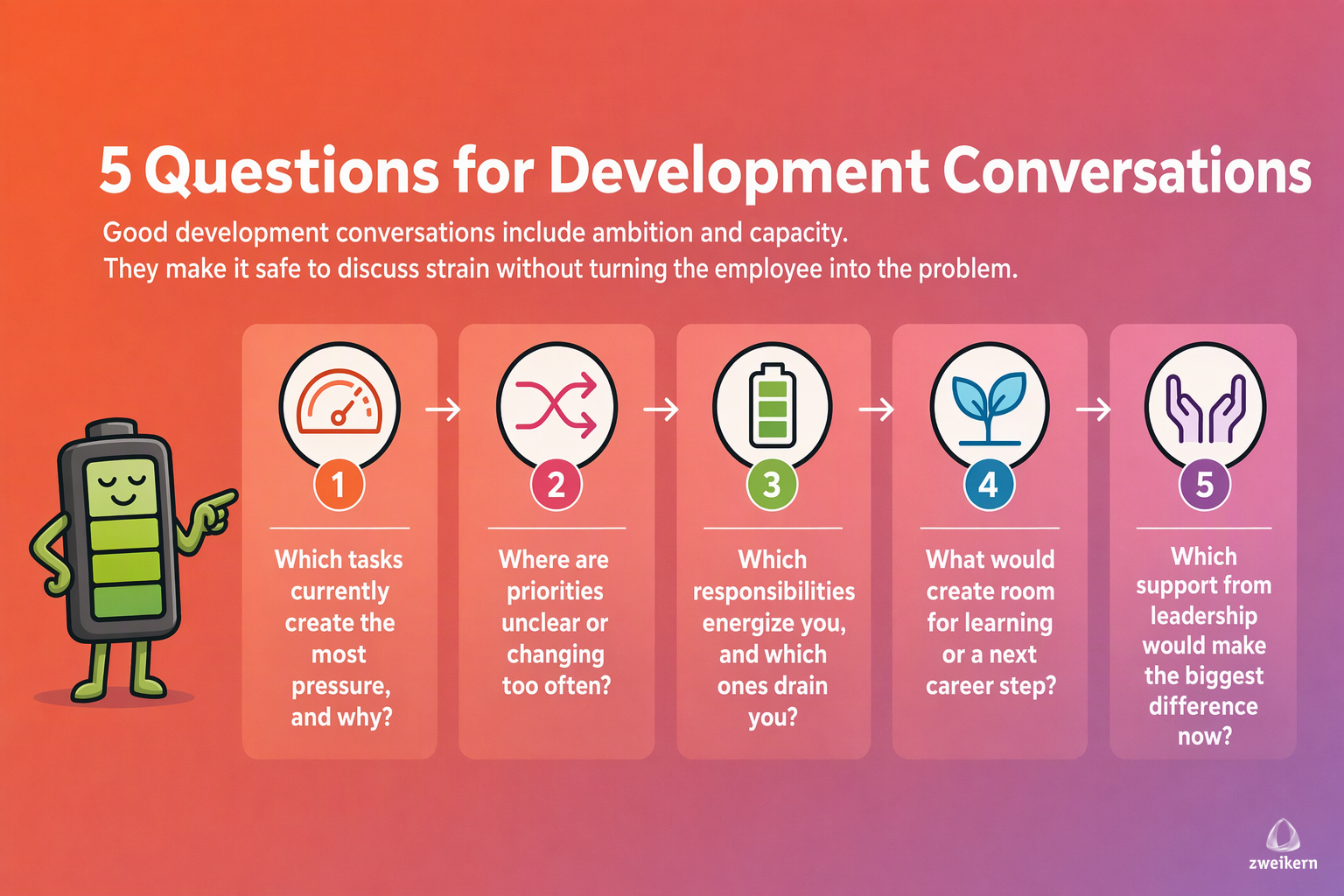
Questions for development conversations
Good development conversations include ambition and capacity. They make it safe to discuss strain without turning the employee into the problem.
Which tasks currently create the most pressure, and why?
Where are priorities unclear or changing too often?
Which responsibilities energize you, and which ones drain you?
What would create room for learning or a next career step?
Which support from leadership would make the biggest difference now?
Leaders need realistic room
Leadership has a direct effect on burnout prevention because leaders shape priorities, meeting culture, feedback, recognition, conflict handling and availability norms. At the same time, many leaders are under serious pressure themselves, especially during transformation, restructuring or cost programs.
Prevention should therefore not mean pushing all responsibility onto managers. Leaders need clear decision paths, realistic resources and usable information about team strain. Otherwise they are asked to protect people while the system rewards speed, escalation and permanent availability.
A useful leadership standard is concrete and observable: make priorities explicit, actively limit work in progress, protect focus time, address conflict early and give recognition for sustainable performance, not only heroic rescue work.
Resilience training can support individuals. It should not be used to compensate for structural overload. When the work system remains unchanged, employees quickly notice the gap between the message and daily reality.
Use data without labeling people
People analytics can support burnout prevention when it is used responsibly. The focus should be aggregated patterns, not individual surveillance. Useful indicators include workload, team climate, engagement, turnover intention, absence patterns, leadership quality and psychological safety.
Interpretation matters. A high absence rate may indicate strain, but it can also have other causes. A highly engaged team may be working in a healthy rhythm, or it may be over-adapting to unrealistic expectations. Quantitative data should therefore be combined with qualitative formats such as interviews, focus groups, retrospectives and leadership conversations.
For culture measurement, the goal is not a scorecard for its own sake. The goal is to make blind spots in the reality of work visible so HR, leaders and employees can make better decisions together. Teams that want to turn survey results into action can also use employee survey follow-up to work on results in a shared space.
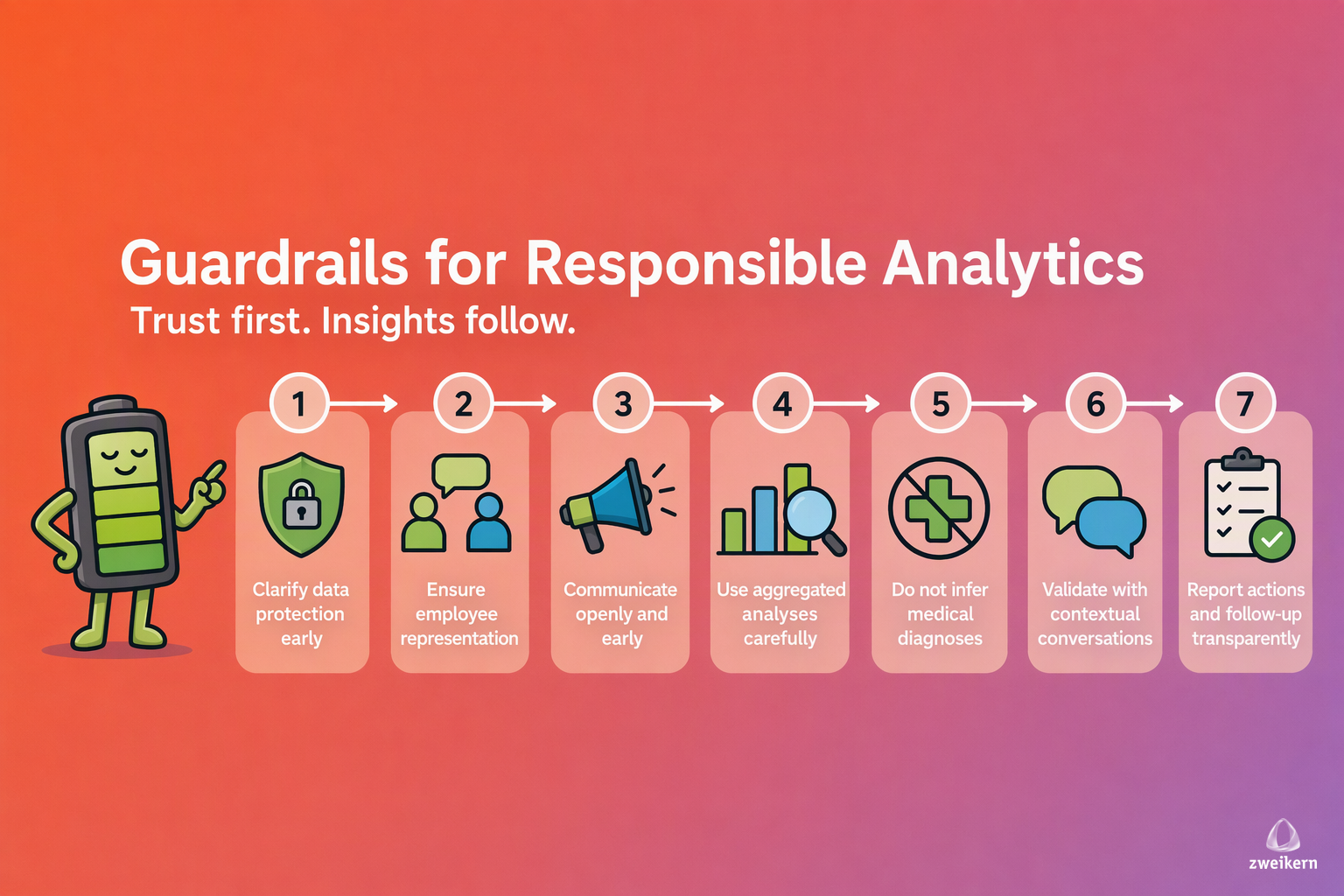
Guardrails for responsible analytics
Data can make psychological strain discussable, but only when the process is trusted. Privacy, communication and participation need attention before the first dashboard is shown.
Clarify data protection, employee representation and communication early.
Use aggregated analyses carefully, especially in small teams.
Do not infer medical diagnoses from behavioral or survey data.
Validate survey findings through contextual conversations.
Report agreed actions and follow-up transparently.
What to do next
Burnout-Prevention is not an extra topic for quiet periods. It belongs near the center of modern organizational development because ignored strain costs more than working time. It erodes trust, learning capacity, leadership credibility and employee retention.
The most sensible next step is an honest look at working conditions: Which demands are increasing? Which resources are missing? Which signals are being normalized? Which talent decisions unintentionally reward overload?
Organizations that approach prevention systematically improve the conditions for sustainable performance. They make psychological strain visible, connect it with leadership and culture, and protect development before people drop out.
If you want to reflect on these topics regularly, follow zweikern content on culture, leadership and organizational development, or start a conversation about how psychological strain can become measurable and discussable in your organization.