In Brief
When organizations systematically capture skills for succession planning, they identify internal talent earlier. Succession planning becomes more effective when organizations look not only at positions and people, but clearly define the skills required for them. Skills data shows which capabilities are critical in key roles, which employees already have them and where targeted development is needed. For HR, this creates a structured process: identify key roles, define skills profiles, map internal talent pools and derive development measures. Clean data, clear governance, data protection and acceptance among managers and employees are essential. Tools such as Lianova can support skill-based people decisions; they make decisions more transparent, but they do not relieve the organization of the responsibility to interpret skills data professionally, discuss role interests and development paths with employees and make the final succession decision responsibly.
Why Traditional Succession Planning Often Starts Too Late
In many companies, succession planning only becomes urgent when a manager resigns, an expert retires or a key role has to be filled again due to restructuring. Then time pressure builds: Who can take over? Who is available? Who knows the processes, customers, systems or regulatory requirements?
The problem is rarely just a lack of talent. Often, there is a lack of transparency about which skills are truly required for critical roles and which employees already have these skills in part or in full. As a result, succession planning remains dependent on personal impressions, networks and short-term assessments.
Skills data shifts the perspective: away from the question of who is currently seen as the obvious successor and toward the question of which capabilities, experiences and development potential exist within the organization. This does not automatically make succession planning perfect, but it does make it more systematic, more traceable and easier to connect with employee development, internal mobility and strategic workforce planning.
What Skills Data Can Do in Succession Planning
Skills data describes which capabilities, knowledge, experiences and behaviors are relevant for a role and to what extent employees already have them or can develop them. It is particularly valuable for succession planning because it makes role requirements and people profiles comparable on a shared assessment basis.
A simple example: For a key role in a production environment, technical process knowledge, leadership experience, occupational safety, stakeholder communication and change capability may be relevant. Without a skills model, the question is often only who knows the department well or has been there long enough. With skills data, it becomes visible which requirements are critical, which candidates already show a strong fit and which gaps would need to be closed through development.
What matters is this: skills data should not create a rigid ranking of people. It is an input for decision-making. Good succession planning combines data with leadership assessment, development conversations, career interests and organizational context, such as current team structures, strategic priorities or upcoming changes. In organizations, this balance is important because transparency, participation and trust are crucial for acceptance.
A Pragmatic Process: From Key Roles to Talent Pools
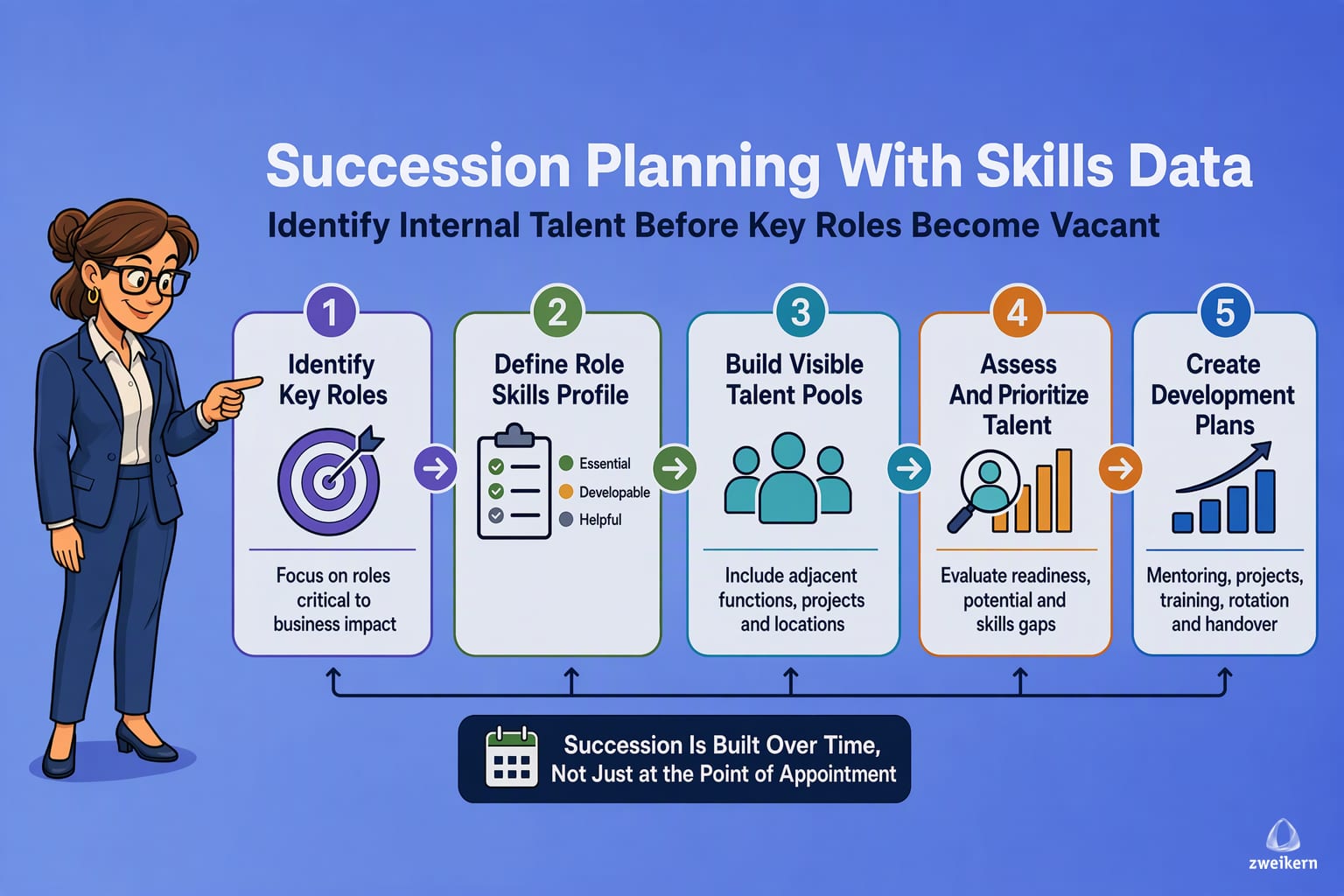
Succession planning with skills data does not have to start with a complete skills catalog for the entire company. A focused starting point is often more effective: Which roles would have the greatest impact on operational stability, customer relationships, revenue, regulatory security or transformation if they became vacant?
The next step is a clear skills profile for each key role. HR and the relevant business function should jointly distinguish: Which skills are essential? Which can be developed? Which experiences are helpful but not mandatory? This distinction prevents succession profiles from becoming unrealistic wish lists.
Making Internal Talent Pools Visible With Skills Data
Internal talent pools can then be built. The focus should not only be on direct deputies, but also on employees from adjacent functions, project roles or locations. This is exactly where skills data creates value: it makes less obvious candidates visible who would not automatically appear in a traditional staffing process. Hidden talent thus becomes accessible, and costs for expensive headhunting processes can be reduced significantly.
Development plans emerge from matching role requirements with existing skills. These may include mentoring, project responsibility, job rotation, targeted training or handover phases. The actual succession planning therefore does not only happen at the point of appointment, but in the time leading up to it.
Data Quality, Data Protection and Trust Determine Success
Skills data is only as useful as its quality and acceptance. If profiles are outdated, inconsistent or difficult to understand, they create false precision. If employees do not know what data is being used for, mistrust arises. Both weaken succession planning.
That is why clear rules are needed:
Who maintains skills data?
Who is allowed to view it?
How often are profiles updated?
Are self-assessments, manager assessments, project experience or learning records used?
And how is it ensured that data does not prematurely define people instead of enabling development?
Acceptance and participation among the workforce are the most important foundation for the success of data-based succession planning. Skills data should not be introduced as hidden performance monitoring. A clear narrative is better: the organization wants to make internal opportunities more visible, support development more precisely and secure critical roles more predictably.
The language used in the skills model also matters. Abstract terms such as leadership, agility or strategic thinking are of little help if they are not described in observable terms. Concrete behavioral anchors and context-specific examples that managers and employees recognize in everyday work are better.
How Software Helps Without Automating the Decision
A skill-based platform such as Lianova can structure succession planning because it brings role requirements, skills profiles, talent pools and development needs together in one place. This makes conversations between HR, managers and executive leadership more concrete: the discussion is not only about names, but about fit, risk, development and timing.
This does not disconnect succession planning from the organization; instead, it embeds it more effectively into existing leadership and development conversations. Skills data creates a shared basis on which HR, managers and executive leadership can discuss potential, mobility and development needs. Precisely for this reason, the cultural dimension remains important: transparency, trust and good leadership determine whether employees experience internal development as a genuine opportunity.
A good starting point is a pilot with a small number of critical roles. HR can work with executive leadership and selected business functions to review which skills data already exists, which data is missing and which decisions can be better prepared as a result. Step by step, this creates succession planning that is closer to the organization’s actual capabilities, development paths and needs. When skills data is used transparently and combined with good leadership, internal talent can be identified earlier and key roles can be filled more proactively.