Skilled workers are people with qualifications, experience, or verifiable skills for demanding tasks. For companies, it is not enough to look for these people only in the labor market. What matters is making existing capabilities inside the organization visible, describing roles clearly, and promoting development wherever bottlenecks are likely to emerge. Companies that understand skilled workers as skill profiles can plan earlier, fill more roles internally, safeguard critical knowledge, and use external recruiting more selectively.
Skilled Workers Are More Than Job Titles
Many discussions begin with open positions. That is understandable, but it does not go far enough. A position describes where someone sits organizationally. The better question is: Which tasks need to be done, what responsibility is attached to them, and which capabilities does a person need for that work?
For HR and leaders, this makes the term more practical. Skilled workers are not simply people with a specific degree. They contribute knowledge, routine, judgment, and the ability to learn in a concrete work context. In some areas, a formal qualification matters. In others, suitability becomes more visible through project experience, system knowledge, or confident handling of customer situations.
This changes workforce planning. Instead of only looking for a replacement for an advertised role, it is worth looking at task clusters, critical knowledge, and development paths. This makes it clear whether a bottleneck really has to be solved externally or whether internal talent can become effective more quickly with the right support.
How Qualification Becomes Concrete
A qualified specialist usually means a person who is qualified for a specific activity and can perform it reliably. This qualification may come from vocational training, university education, further training, certification, or relevant professional experience.
In everyday business, however, the term should not be used only in a formal sense. A person may list project management on their resume, but may still lack stakeholder experience, budget responsibility, or process knowledge for a critical transformation role. Conversely, someone without the perfect title may have exactly the skills a team needs right now.
In regulated fields of work, the definition is narrower. In integration assistance in Germany, the question of who counts as a qualified professional depends, among other things, on legal requirements, service agreements, state-level framework contracts, facility concepts, and recognized professional qualifications. Companies and providers should always check these requirements for their specific context instead of deriving them from general glossaries.
Where Bottlenecks Really Emerge
The question of where qualified people are lacking cannot be answered permanently with a single ranking. Bottlenecks change according to region, industry, economic conditions, qualification level, and political framework. Health and care professions, IT, technical occupations, electrical and mechanical engineering, skilled trades, construction, education, and social professions are often under pressure.
For companies, this rough industry list is only the starting point. Their own bottleneck map is more critical: Which roles stop projects if they remain vacant for three months? Where does knowledge depend on just a few people? Which teams are already compensating for missing capacity through overtime, workarounds, or lower quality?
An external bottleneck often becomes visible only after little internal transparency has been built up over years. If no one can clearly see who has which capabilities, two risks arise at the same time: open positions remain unfilled while suitable people inside the company are overlooked. The article Counteracting talent shortages with internal mobility shows how companies can activate this potential before launching an external search.
Skill Data Makes Demand Decidable
Many organizations know their staffing plans better than their capability landscape. That is convenient in day-to-day business, but it becomes costly as soon as priorities shift. An organizational chart shows responsibilities. It does not reliably show who has mastered a specific system, who has experience with difficult customer segments, or who could take on a larger role in six months.
A useful skill logic does not have to start in a complicated way. What matters is that it improves decisions. HR does not need an endless competency library for this, but a clear connection between role requirements, existing capabilities, and realistic development steps.
An employee competency profile helps make this connection visible: Which capabilities are documented, which experiences fit a task, and which gaps can be closed through learning, mentoring, or project practice?
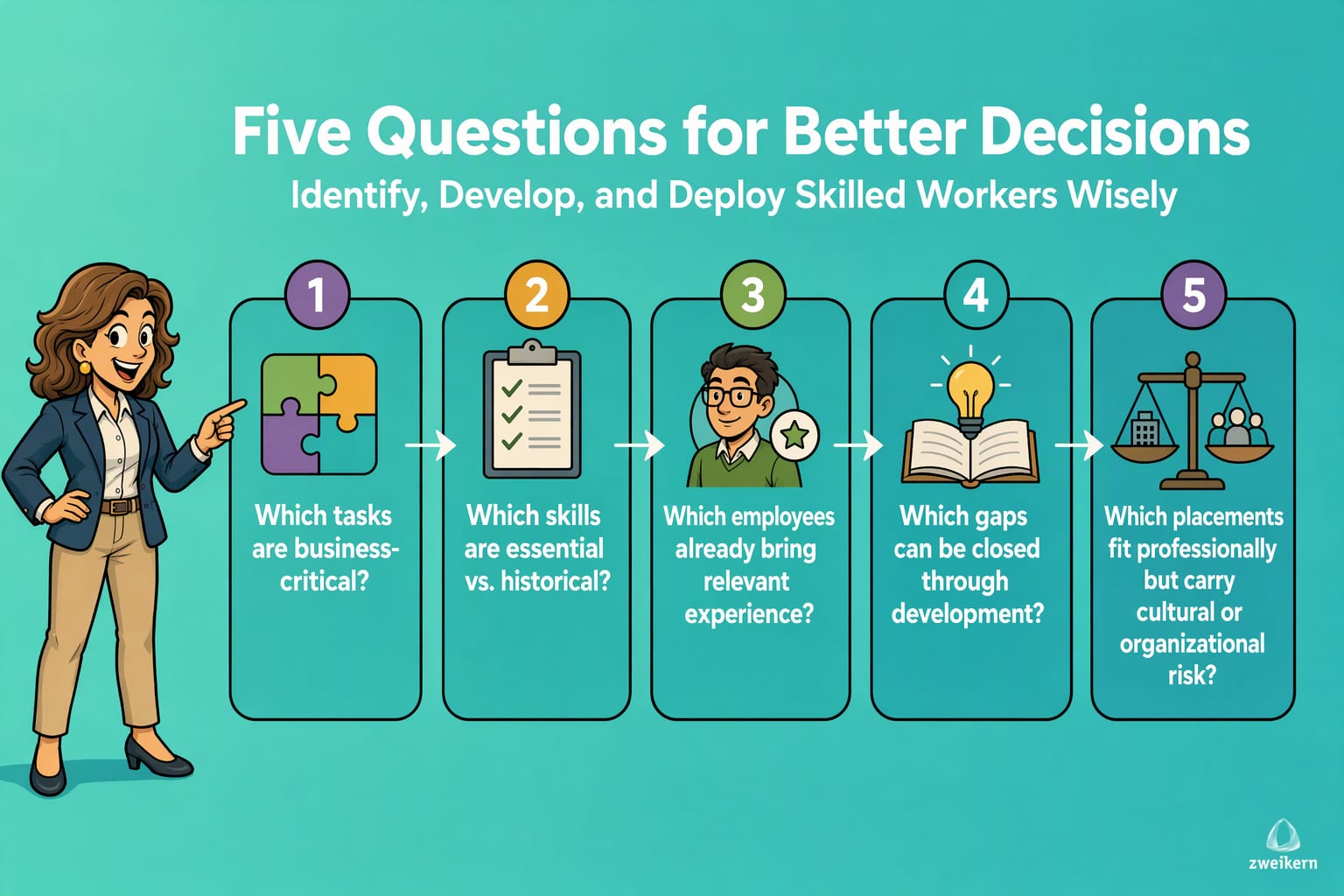
Five Questions for Better Decisions
Before a role is automatically advertised externally, it is worth briefly comparing demand, existing skills, and development options.
Which tasks are business-critical when capacity becomes scarce?
Which skills does a role really need, and which requirements have simply grown historically?
Which employees already bring relevant experience?
Which gaps can be closed through learning, mentoring, or project practice?
Which placements fit professionally but carry cultural or organizational risk?
Development Comes Before External Search
When a key role becomes vacant, external recruitment is often necessary. Even so, it should not be the only answer. Companies that want to retain skilled workers need visible development paths: deeper subject-matter expertise, lateral moves, project roles, mentoring, succession options, and clear learning opportunities.
Experienced employees in particular rarely leave organizations only for the next salary increase. They also leave when their capabilities are not seen, when they have been doing the same work for years, or when career progression is understood only as a management track. A strong expert career path needs recognition, room for decision-making, and challenging tasks without the obligation to take on line management.
Internal mobility is more than a move into an open position. It connects workforce planning, talent development, and knowledge retention. The article on redeployment with the right skills explores in more depth how roles, capabilities, and workforce restructuring can work together.
Technology can structure this work as long as it does not oversimplify the decision. A platform can bring together role requirements, digital skill profiles, and development opportunities. For targeted development paths, Lianova shows how employee development with skill goals can be planned.
Knowledge Must Not Depend on Individuals
A bottleneck does not begin only when a position is vacant. It often starts earlier: an experienced person knows the critical customers, the special case in the system, the unofficial process, or the history behind a decision. If this knowledge is not documented, shared, or translated into succession planning, every departure becomes more expensive.
Knowledge retention is therefore part of a skilled talent strategy. Companies should not only count how many qualified people they have, but also examine where experiential knowledge is concentrated. The article on critical knowledge loss in companies describes how organizations can identify such risks earlier.
The Future Begins With Tasks
The better question is not only which occupations have a future. What matters is which tasks remain important even as technologies, markets, and business models change. Future-proof activities usually combine subject-matter knowledge with problem solving, responsibility, communication, or systems understanding.
Depending on the organization, these include care and health, technical maintenance, IT security, data and process expertise, energy and environmental technology, education, social work, product development, and roles at the interface between people, organization, and technology.
For workforce strategy, this means that not every trending occupation has to be built internally. But every organization should know which capabilities will become scarcer, more expensive, or more strategic over the next two to three years. This leads to better learning paths, more targeted job profiles, and more realistic succession planning.
Brief Answers From Practice
The following questions often arise when companies shift their search for qualified people from job ads to skills, roles, and development.
When Does Someone Count as a Qualified Specialist?
A person counts as a qualified specialist when they are qualified for a specific activity and can perform it reliably. The basis can be a degree, but also further training, certification, or verifiable professional experience.
Which Occupations Have a Future?
Future-proof activities are primarily those that combine subject-matter knowledge with problem solving, responsibility, and systems understanding. The concrete answer depends on the business model: an industrial company needs different profiles than a hospital, a public provider, or a software company.
What Matters Now
Companies that want to attract and retain skilled workers should not start with the job ad. The more effective starting point is transparency: Which capabilities are available, which roles need them, which people can develop in that direction, and where is external search truly unavoidable?
This turns reactive search into a better workforce decision. Skilled workers are then seen not only as a scarce resource in the market, but as capabilities, experience, and potential inside the organization.