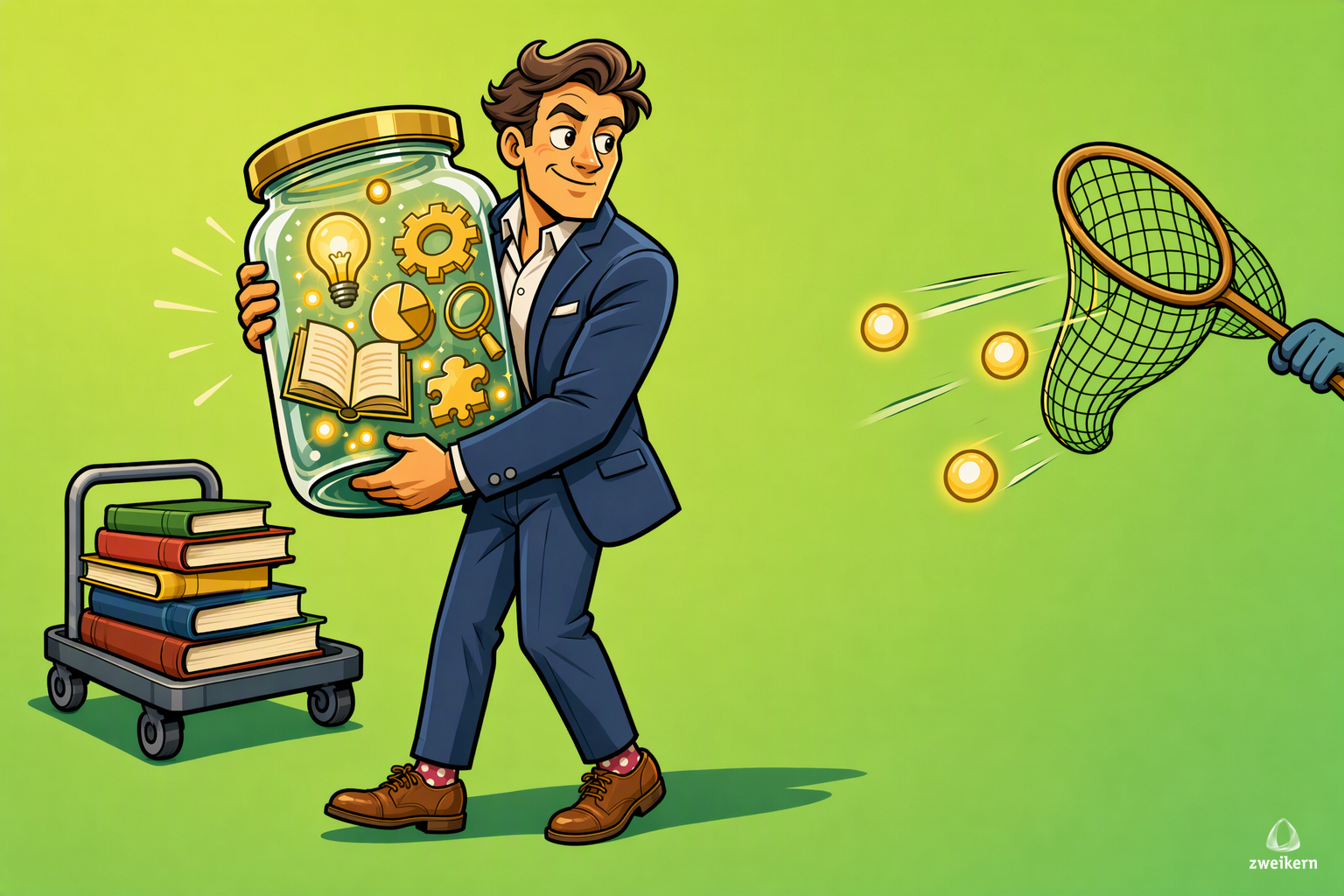
Knowledge loss in companies rarely happens because too little was documented. It becomes critical when experienced employees leave and take customer histories, process logic, decision knowledge and informal networks with them. CEOs should therefore clarify early which roles are business-critical, where knowledge depends on individuals, and how succession planning, upskilling and knowledge transfer can be managed based on data.
Detect Knowledge Loss in Companies Early
When knowledge loss affects companies, it is often only noticed once the person concerned has already left. Then a project is delayed, a customer has to explain their own history, a machine behaves differently than expected, or a decision is discussed again even though it was deliberately made that way years ago.
For CEOs, this is not a side issue for HR. Knowledge loss connects several management topics: productivity, delivery capability, quality, succession readiness, transformation speed and risk management. Those who only act when someone leaves are already working in repair mode.
The most important shift in perspective is this: knowledge is not just content in folders, wikis or process manuals. It also lives in routines, exceptions, relationships, judgment and the ability to choose the right shortcut in unclear situations.
Which three people could not be absent tomorrow without customers, projects or decisions being noticeably affected?
Which roles are especially important for securing revenue, quality, compliance or delivery capability?
Where do only individual employees know why certain paths are deliberately no longer taken in the company?
Which departures, retirements or internal moves are foreseeable and not yet secured through succession or transfer?
Which Types of Knowledge Are Really at Risk
Not all knowledge deserves the same level of protection. Some information can be documented, standardized or automated cleanly. It becomes dangerous where knowledge is tied to specific people and, at the same time, has a direct impact on revenue, quality, regulatory security or customer satisfaction.
Typical risk areas include customer and supplier histories, specialist knowledge about legacy systems, implicit quality standards, escalation paths, project decisions, informal networks and experiential knowledge from special cases. This organizational knowledge in particular often appears only partially in traditional handovers.
Clean knowledge transfer therefore does not begin with the question of which tool should be filled. It begins with the question of which knowledge is critical for value creation and where it is currently still too strongly tied to individual people.
The Why Behind Decisions
Many handovers explain what needs to be done. They less often explain why something is done one way and not another. This knowledge of the why is especially valuable for new owners because it makes old mistakes, political dependencies, customer preferences and technical limits visible.
Without this context, successors may see process descriptions but not the logic behind them. Decisions are then reversed, earlier dead ends are repeated, or risks are underestimated that experienced employees had previously absorbed quietly.
Early Warning Signs in Everyday Work
Knowledge loss rarely announces itself with a clear alarm. Most of the time, it appears in small friction losses: the same questions keep coming up, decisions are referred back to individual people, new employees take unusually long to become effective, or teams avoid tasks because only one person can handle them reliably.
Another warning sign is unofficial experts without whom supposedly normal processes do not run. When organizations only function because individual people close gaps, that is not proof of exceptional efficiency. It is a structural risk.
Transformations also expose knowledge gaps. When departments are merged, roles are changed or employees are reskilled, it quickly becomes clear whether skills and experiential knowledge are transparent. Anyone looking at change systematically will find additional starting points for connecting roles, culture and development in the article on people and organizational development.
What CEOs Can Do Before Employees Leave
The best time to prevent knowledge loss is before resignation, before retirement and before restructuring. CEOs should therefore not treat knowledge retention as a late-stage offboarding issue, but as part of corporate management.
First, transparency is needed around critical roles and skills. Which functions secure value creation, customer loyalty, quality or regulatory stability? The next question concerns dependencies on individuals: where is business-critical knowledge tied to individual employees? Only then can suitable transfer paths be defined.
Such transfer paths can include mentoring, tandems, job shadowing, communities of practice, documented decision logic or targeted succession development. For teams that want to secure experiential knowledge and keep it available, knowledge transfer with digital twins is a fitting next look at the product page.
The sequence matters. Many companies start with documentation. It is often more useful to first make critical knowledge areas, skill gaps and succession options visible. Then it becomes clear what needs to be documented, trained, distributed, automated or supplemented through recruiting.
Mark critical knowledge roles: which positions are especially important for revenue, quality or stability?
Make one-person dependencies visible: where is there no reliable replacement or deputy?
Prioritize transfer measures: which knowledge must be documented, practiced, shared or transferred into roles?
Review succession planning: which employees could take on responsibility with upskilling?
Review progress quarterly: have risks decreased, or have they only shifted?
Why Databases Alone Are Not Enough
Knowledge databases can be helpful. But they only solve part of the problem. They store information, but they do not automatically create the ability to act. If no one knows which knowledge is critical, who has it and which skills will be needed in the future, documentation remains passive.
Knowledge loss in companies is therefore closely linked to transparency around skills and competencies. The better questions are: who can do what? Where can knowledge be transferred? Which teams are over- or under-supplied? Which employees could take on new tasks with upskilling?
This is where competency management becomes strategic. Instead of merely filing knowledge away, companies connect skills, role requirements and people decisions. That is the core of skill-based people decisions: staffing, development and succession are aligned more closely with the competencies and experiences that are actually available.
A competency profile helps make this perspective tangible. The article on managing employee competencies explains in more depth why résumés and job titles are not enough for this.
A Simple Knowledge Risk Map
CEOs do not have to predict knowledge loss completely. But they can make the biggest risks visible before they become costly. To start, a repeatable view of critical roles, central skills, foreseeable departures, succession options and upskilling needs is enough.
A knowledge risk map shows which areas depend heavily on individual people, where a generational change is approaching, and which skills are decisive for transformation or growth. It also shows where employees are already available who could take on more responsibility with targeted development.
For Lianova, this perspective connects especially well: the digital twin for competencies and knowledge bundles experience, skills and development potential in one profile. As a result, knowledge is not only archived, but made usable for better people decisions.
For zweikern Insights, the cultural side also remains relevant. Knowledge is only shared when trust, willingness to learn and leadership practices support it. Otherwise, perfect repositories emerge, but no living transfer of knowledge.
What Remains
Knowledge loss in companies is not purely a documentation problem. It occurs when critical experiential knowledge, skills and decision context are too strongly tied to individual people.
Anyone who wants to prevent knowledge loss should not wait until offboarding begins. The effective path runs through transparency: identify critical roles, name dependencies, strengthen succession planning, build competency management and organize knowledge transfer deliberately.
If you are currently discussing these questions for CEOs, HR or transformation, it is worth having a conversation about your knowledge risks. The zweikern newsletter also provides ideas for data-based organizational development and robust people decisions.