Finding talent is hard enough. Keeping people in the organisation and developing them in a focused way is even more challenging. Many organisations talk about talent management, but in everyday practice they work mainly with job descriptions, CVs and individual observations.
If you really want to understand which capabilities people bring to the table and how they can grow, you need a clear employee competency profile. Not as a static form, but as a living picture of skills, strengths and potential.
This is where a modern approach to competency profiles comes in. And this is where Lianova, with digital heroes, Lifepathing and matching, can make a real difference.
Why competency profiles for employees matter
Competency profiles are the foundation for almost every central topic in talent management. Without them, much remains vague and reactive.
With a solid employee competency profile, organisations can
make visible which competencies already exist in the company
decide more precisely who is suitable for which tasks and projects
plan development paths and career journeys in a meaningful way
base redeployment and internal mobility on facts instead of gut feeling
Without competency profiles, typical patterns emerge. A few experts are overloaded because only they have the required knowledge. Talents are overlooked because they sit in parts of the organisation that do not match their future potential. Learning and development plans training from a catalogue instead of from real competence needs.
What an employee competency profile should contain
An effective competency profile is more than a list of buzzwords. It connects tasks, behaviour and potential in a structured way.
Typically, a competency profile covers four areas.
Professional competencies
This area focuses on knowledge and experience in specific fields of work. Examples include product expertise, technology knowledge, understanding of the industry or experience with particular methods or procedures.
The key is to relate the description to everyday work. It is not just the name of a system that counts, but how someone uses it to solve real problems.
Methodical competencies
Methodical competencies describe how people approach tasks. They include, for example, analytical thinking, facilitation, project steering, process understanding or working with data.
This area often decides whether someone can structure complex topics and support or lead change in a reliable way.
Social competencies
Here it becomes visible how collaboration and communication work in practice. Relevant competencies include teamwork, empathy, conflict skills, de escalation, stakeholder management or negotiation skills.
Especially in roles with many interfaces, these competencies are often the difference between success and failure.
Personal resources
Personal resources encompass inner attitudes and patterns. Examples are willingness to learn, resilience, self reflection, ownership or initiative.
These resources strongly shape how people deal with uncertainty, pressure and ongoing change. They are often underrepresented in classic profiles, although they are critical for sustainable performance.
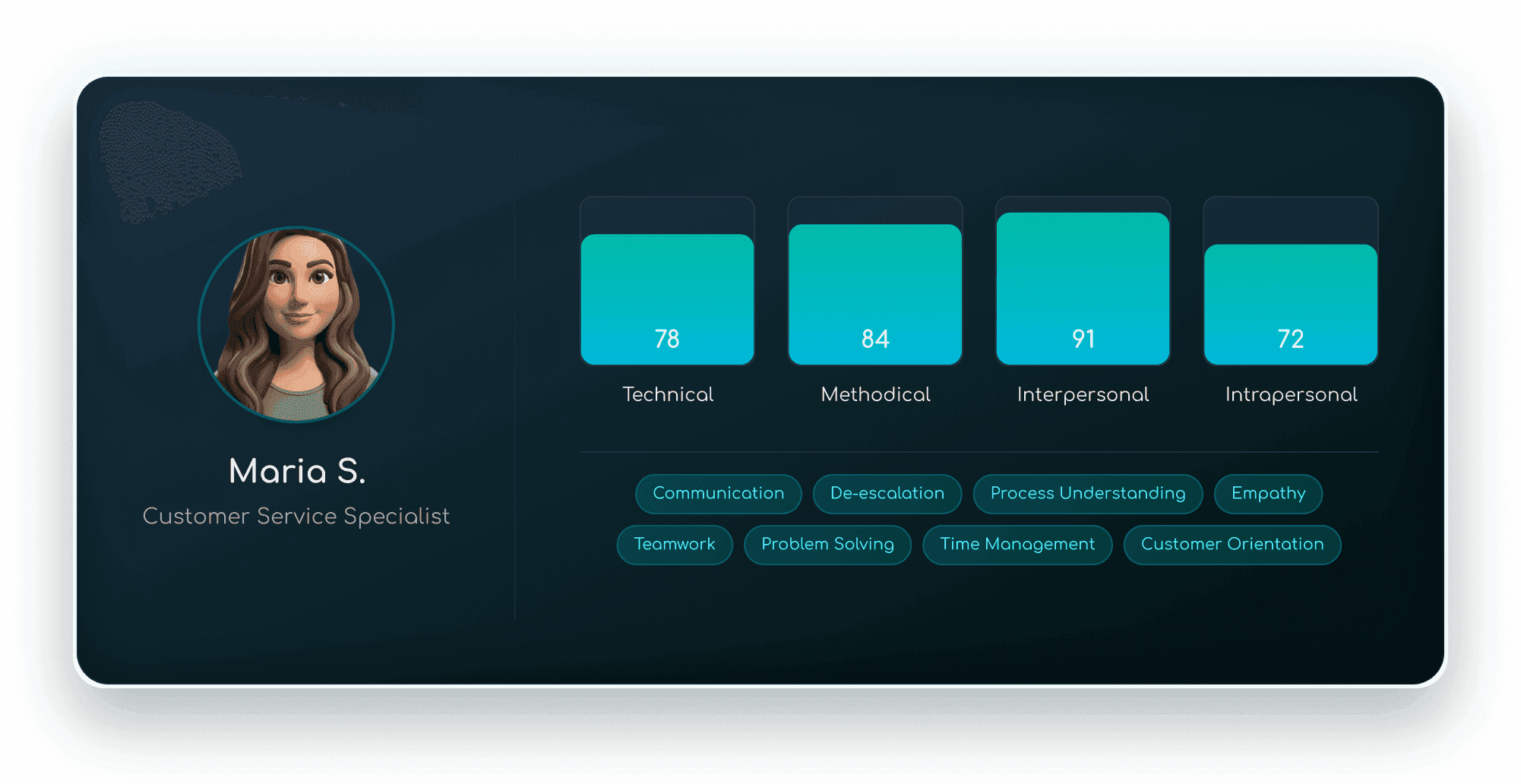
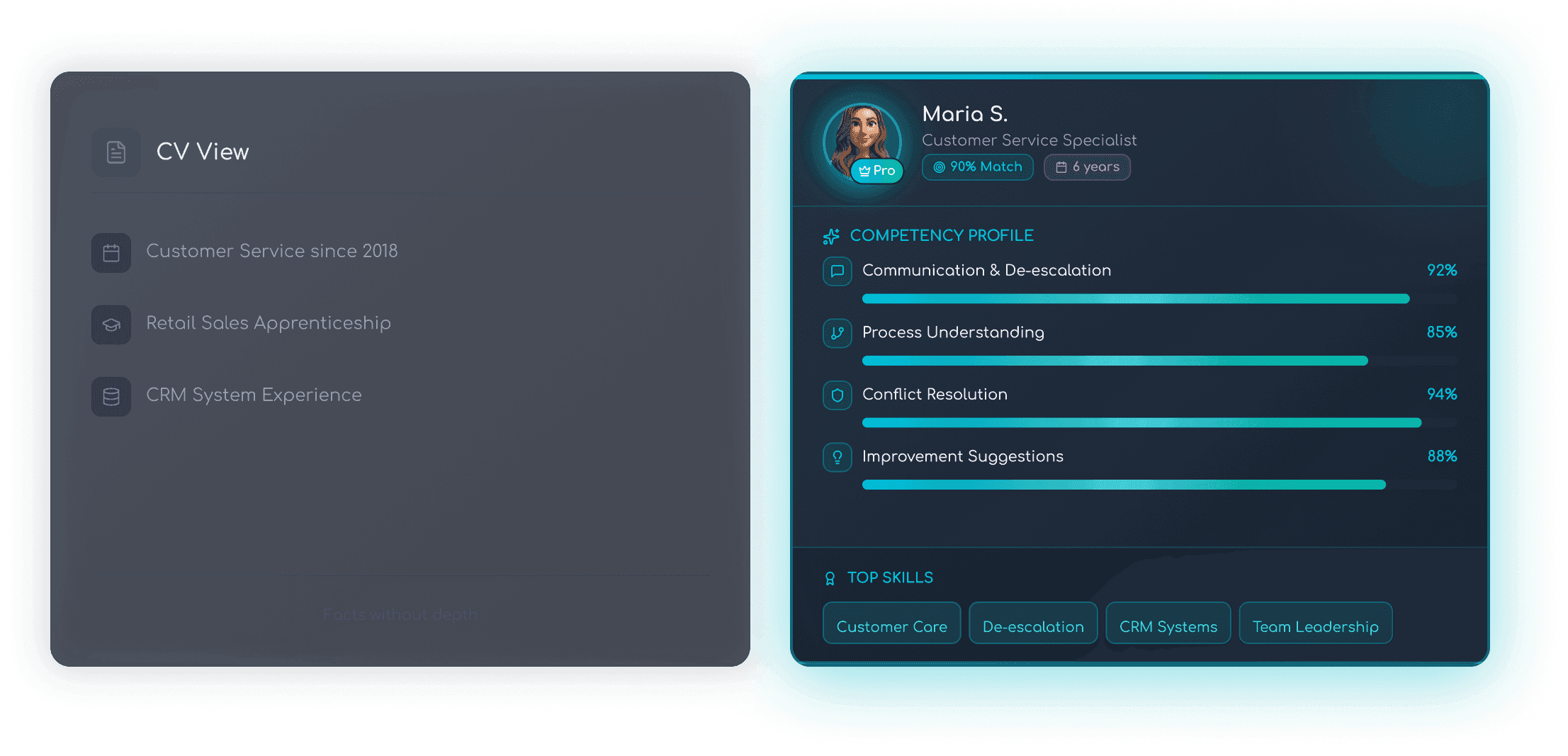
Competency profile example from customer service
A concrete example makes this more tangible. Imagine an employee in customer service who is taking on more responsibility in the area of customer experience.
Her competency profile could show, among other things, that she
masters the full product portfolio and the key service metrics, and works confidently with the ticket system and knowledge base
structures customer issues by urgency, evaluates feedback and derives patterns for process improvements
contributes to projects that optimise service workflows and prepares results in a way that stakeholders can easily understand
systematically de escalates critical conversations, communicates clearly and in a way that fits the audience, and has built stable relationships with sales and technical teams
remains calm in peak workloads, handles frustration constructively, raises improvement needs proactively and delivers reliably even under pressure
In a visual competency profile, these aspects can be shown as clusters with levels. At a glance, it becomes clear where particular strengths lie and where deeper development would be useful, for example towards customer experience management or project roles.
Leadership competency profiles as a specific case
For leaders, additional requirements apply. A leadership competency profile builds on the same areas, but adds capabilities in leadership and organisation.
These can include, for example
shaping conditions and team culture
conducting conversations on goals, development and feedback
prioritising and making decisions when objectives are in conflict
providing orientation and psychological safety during transformation
A clear leadership profile helps prevent people from moving into leadership roles just because they are strong specialists. Instead, the organisation deliberately checks whether core leadership competencies are present or can realistically be developed.
How companies create competency profiles in a systematic way
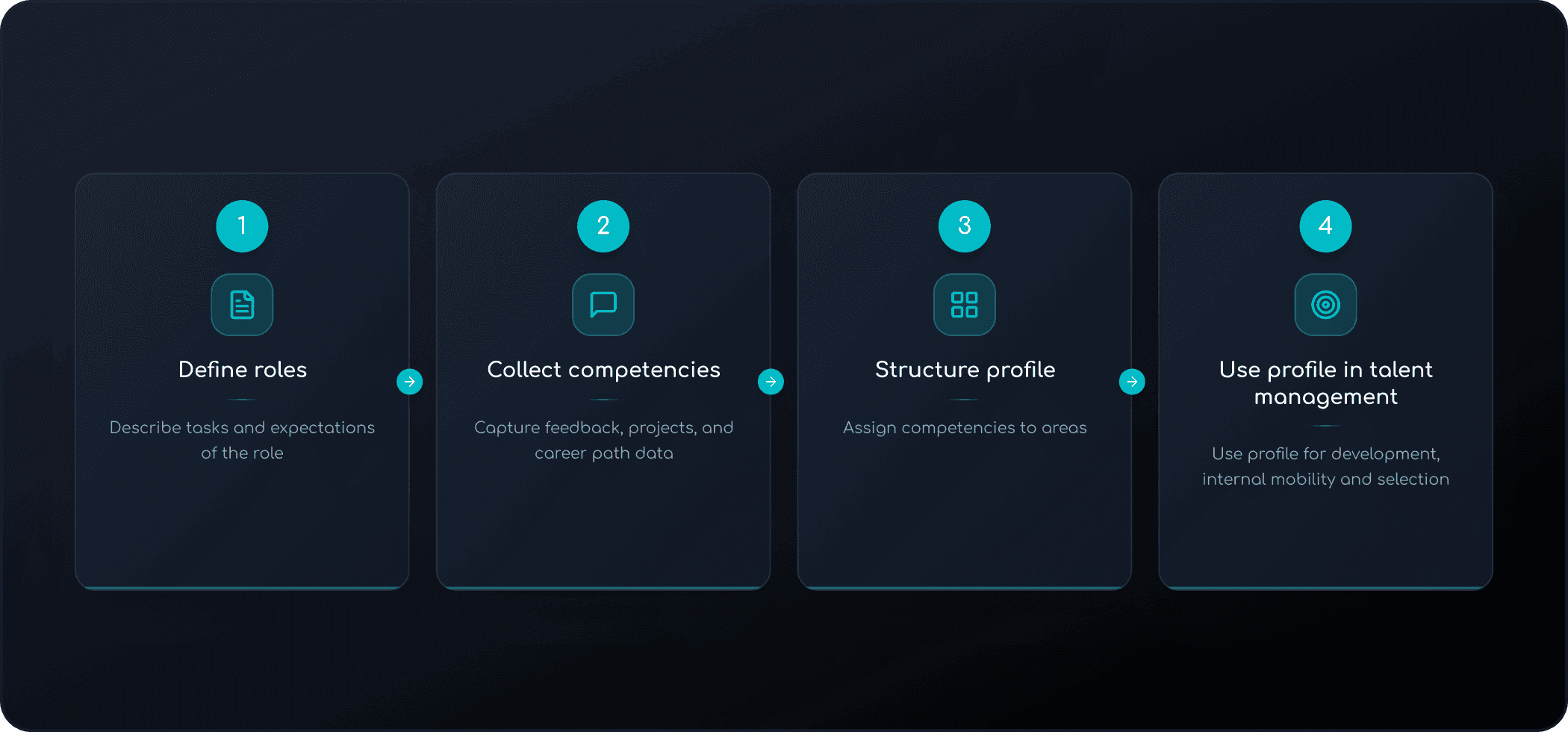
A competency profile does not appear by chance. It needs a clear process and a shared language.
A practical approach can be structured in three steps.
Clarify roles
At the beginning, roles are in focus. Which tasks shape the day to day reality of a role. Which typical situations occur. What outcomes are considered successful.
From these descriptions, competency requirements can be derived. Analytical strength for data roles. De escalation and empathy in customer facing functions. Facilitation and stakeholder management in project roles.
This clear link between role and competencies prevents profiles from becoming generic checklists.
Capture competencies
In the second step, employee competencies are collected. Classic sources include objectives, feedback from projects, performance reviews or structured interviews.
The picture becomes much stronger when life paths are included. Migration, care work, volunteering, failed ventures or informal leadership roles reveal competencies that never show up in a CV, but have a massive impact in everyday work.
By combining current role performance with life experiences, the competency profile becomes a much deeper reflection of what someone can actually do.
Update and use profiles
Competency profiles only unfold their full value when they are updated regularly and actively used.
In practice, this means
updating profiles after major projects or role changes
using them in people discussions and development planning
integrating them into internal postings, project staffing and succession planning
In this way, competency profiles become a living part of talent management instead of a form that disappears in an archive.
Hero profiles with Lianova as a modern competency profile
Lianova goes beyond classic competency profiles by integrating life stories, competencies and personality in one hero profile.
In the first step, employees describe central stages and turning points in guided journeys. From these stories, Lifebubbles emerge – condensed events that are relevant for competencies.
Lianova’s AI assigns these Lifebubbles to four strategic competency areas and adds an archetype profile based on sixty four combinations. The result is a digital hero profile that
captures professional, methodical, social and personal competencies
makes working style and typical strengths visible
serves as a foundation for matching, skill gap analysis and career paths
Unlike static competency profiles, hero profiles grow with every new experience. They are updated continuously and feed directly into talent management, internal mobility and redeployment.
What companies gain from competency profiles
When competency profiles are used consistently, they change the way organisations work with talent.
Employees understand their own strengths more clearly and see concrete next steps for development.
Leaders make people decisions on a better basis and can assemble teams in a targeted way.
Talent management and learning design programmes based on real competencies instead of just on job titles.
Internal mobility and redeployment are based on an up to date skill picture, not on vague impressions.
Competency profiles are therefore not an extra document, but a navigation tool for the talent journey inside the organisation.
Conclusion: competency profiles as a foundation for modern talent management
A competency profile makes visible what people can really do beyond their job titles. It connects competencies, experiences, strengths and potential into one picture that can be used for recruiting, development, internal mobility and redeployment.
With digital hero profiles, Lianova offers an approach that combines life paths, competencies and personality in a consistent model. Hidden talent becomes visible, career paths become clearer and talent management shifts from an administrative task to a real strategic lever.
FAQ
What is an employee competency profile?
An employee competency profile is a structured picture of a person’s skills, experiences, strengths and potential. It usually covers professional, methodical, social and personal competencies and shows where someone is particularly strong and where further development makes sense.
How does a competency profile differ from a job description?
A job description defines tasks and responsibilities of a role. A competency profile describes how a specific person fills that role: which competencies they actually use in everyday work, how they behave in typical situations and which potential they have for future roles or career paths.
Why are competency profiles so important for talent management?
Without competency profiles, many talent decisions are based on job titles, CVs and individual impressions. With clear profiles, organisations can identify talent more reliably, plan development paths, support internal mobility, design better learning programmes and make redeployment decisions based on facts instead of gut feeling.
What should a good competency profile for employees include?
A good competency profile combines tasks, behaviour and potential. It should cover professional expertise in the relevant field, methodical competencies for problem solving, social competencies in collaboration and communication and personal resources such as resilience, willingness to learn and ownership. Ideally, it also reflects typical strengths and working style.
How can organisations build and maintain competency profiles in a structured way?
A practical approach starts with clear role descriptions and derived competency requirements. Competencies are then captured through feedback, conversations, project experiences and structured tools. Profiles need to be updated after important projects or role changes and actively used in people reviews, internal staffing, career planning and succession discussions.
What role does Lianova play in creating competency profiles?
Lianova turns life paths and work experiences into digital hero profiles. Through guided journeys, Lifebubbles are created and analysed by AI into four strategic competency areas plus an archetype profile. These dynamic profiles make competencies and working styles visible and can be used directly for matching, skill gap analysis, career pathing, internal mobility and redeployment.