Winning talent is hard enough. The real challenge begins afterwards. In many companies there is enormous potential in the workforce, but the way they look at it is surprisingly traditional. Org charts, job titles, job descriptions and CVs still determine who does what. The result: people adapt to rigid roles instead of roles being adapted to the real skills of people.
This is where the idea of the skill based organization comes in. Instead of thinking in functions, departments and hierarchy levels, it puts work, skills and competence profiles at the centre. In an international context people usually talk about the skill based organization. The principle is the same. Organizations are built around skills.
What defines a skill based organization
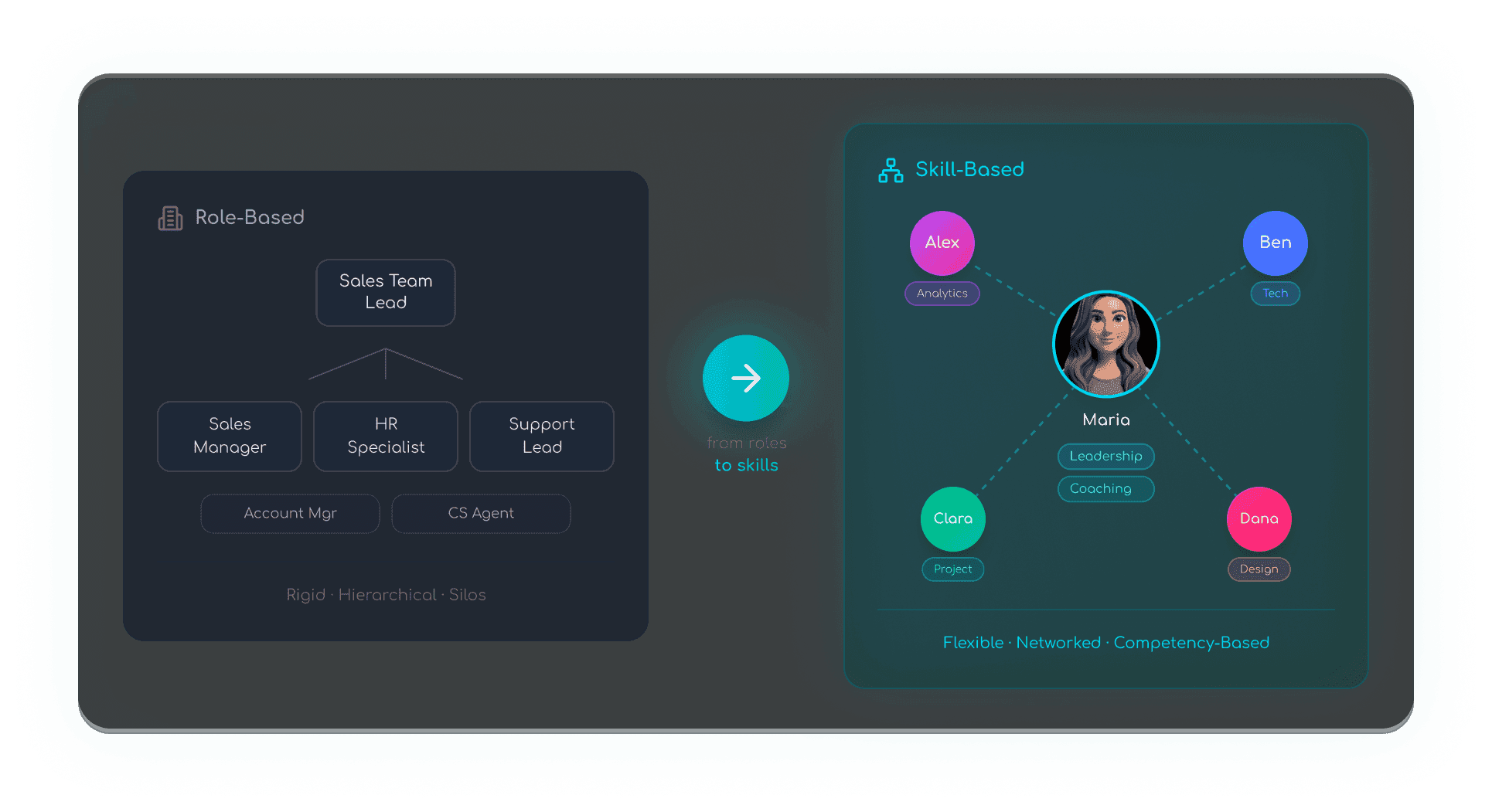
In a classic organization the starting point is almost always the position. There is a vacancy in sales, so the company looks for a person with the right title and some industry experience. The question which concrete tasks are coming up and which capabilities are really needed often comes much later.
A skill based organization turns this logic upside down. It starts with the work that needs to be done. Which tasks are on the horizon in the next months and years. Which skills are required for that. Who in the organization already brings those skills and who could realistically grow into them.
Org charts do not disappear. But they are complemented by a living picture of the competencies that exist in the organization. Teams are composed more consciously based on skill profiles. Internal mobility and redeployment rely on facts instead of spontaneous impressions.
From position logic to skill logic
The most important shift happens in the way people think. People decisions no longer start with the question which position is open, but with the question which value creation is needed. Only then do we define which combination of skills, responsibilities and roles makes sense.
This leads to more flexibility. Employees can take several roles in different projects. Teams change along the work to be done rather than along the boxes in the org chart. Skills become the central resource of the organization.
Competence types as shared language for skills
For a skill based organization to work, it needs a shared language for competencies. Otherwise every manager will continue to use their own ideas of talent and potential. A proven way to create this language is to work with competence types.
Four competence types as foundation
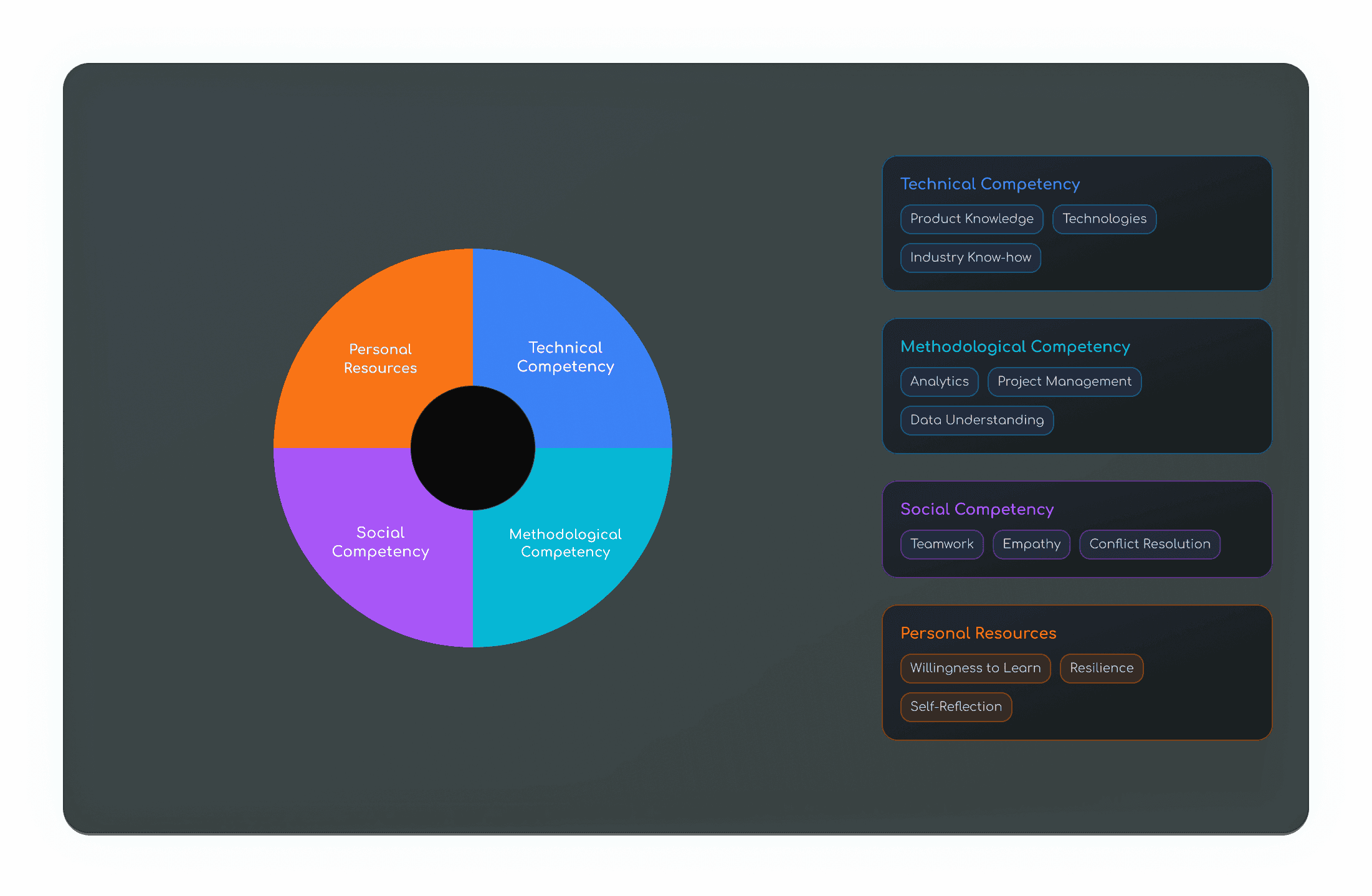
A competence profile for employees typically includes four areas that together form a complete picture.
Professional competencies describe knowledge and experience in concrete subject areas. This includes product knowledge, technology expertise or industry understanding. It is important not only to list which systems someone knows. What really matters is how this person uses their knowledge to solve problems and create value.
Methodological competencies show how someone approaches tasks. Analytical thinking, facilitation, project steering, working with data or process analysis belong into this category. Especially in change projects this area often decides whether a person can structure complex topics and guide others through them.
Social competencies become visible when people work together. Teamwork, empathy, conflict skills, de escalation, stakeholder management and negotiation skills are core examples. Particularly in roles with many interfaces social competencies often make the difference between smooth collaboration and permanent crisis mode.
Personal resources relate to inner patterns and attitudes. Learning agility, resilience, self reflection, ownership and initiative strongly influence how someone deals with pressure, uncertainty and new situations.
Why a shared language is crucial
When organizations use these competence types consistently, a shared map emerges. Skills can be captured cleanly, competence profiles become comparable and role profiles more precise. Leaders, HR and employees talk about the same thing when they discuss professional competence, methodological competence or social competence. That is the foundation for any form of skill management.
How skills steer the organization
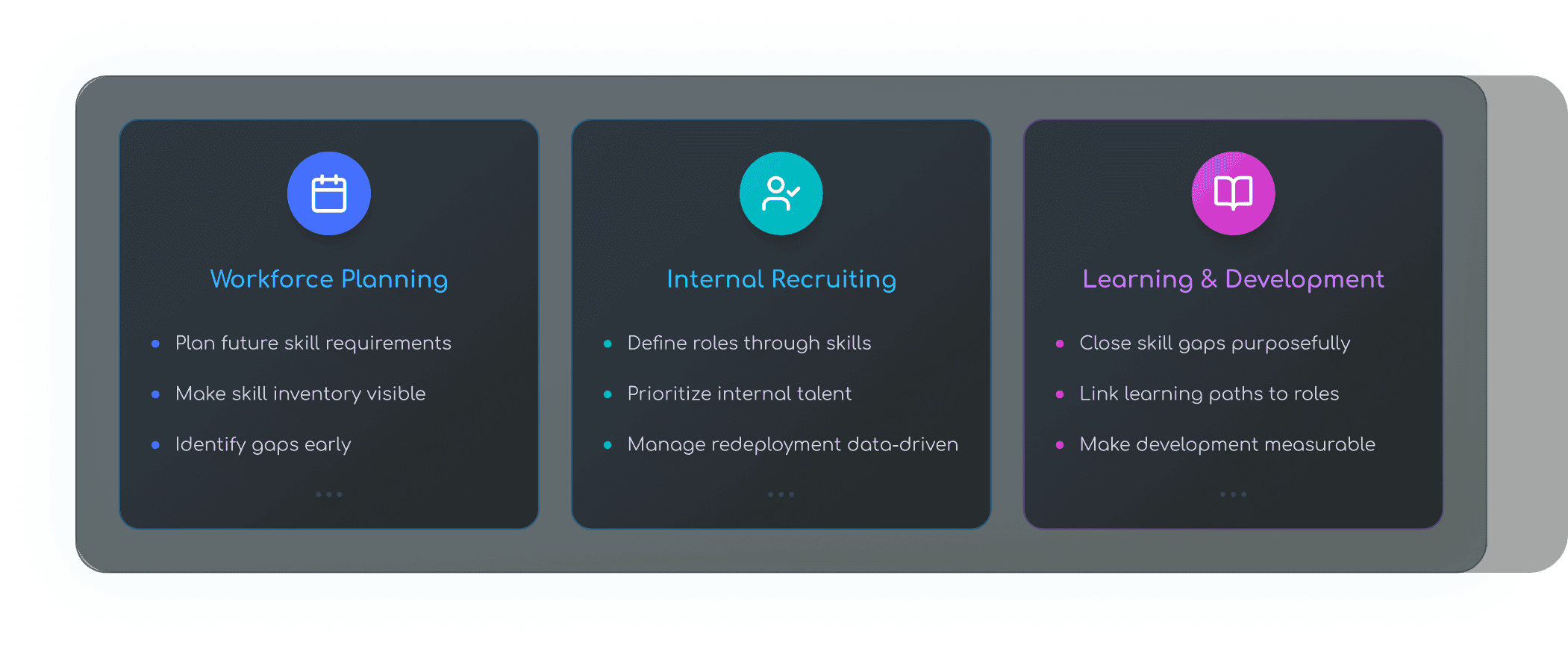
A skill based organization is not a theoretical model. It changes concrete decisions in daily work. Three areas are particularly central.
Workforce planning with a focus on skills
In workforce planning, future needs are no longer defined primarily by headcount but by skills. If it is clear which capabilities are required for new business models, technologies or markets, the organization can build them deliberately.
Skill profiles of the current workforce are compared with planned requirements. This makes it visible early on where gaps will appear and where there are already people with the right potential.
Rethinking internal recruiting
In internal recruiting the focus shifts away from titles and CVs and towards competence profiles. A role is described first via tasks and competencies. Only then do we ask which internal candidates could fit with their skill set.
External hiring remains an option, but it is no longer the default. Redeployment becomes a serious alternative to layoffs, because existing competencies are used in a systematic way.
Learning and development guided by skill gaps
In learning and development, skills become the compass. Learning offers are no longer built mainly around generic topics like leadership or communication, but around concrete skill gaps.
Development paths are linked to role profiles. Employees see more clearly which skills they need for specific career paths and which learning formats will help them get there.
Skill based matchmaking with Lianova
Many organizations do not fail at the idea of the skill based organization, but at its implementation. Data about skills is scattered, hard to compare or simply missing. This is where Lianova comes in.
Digital heroes as competence profiles
The starting point are digital heroes. Employees go through guided journeys and describe key moments in their work and life. From these stories, lifebubbles emerge: condensed events with high relevance for competencies.
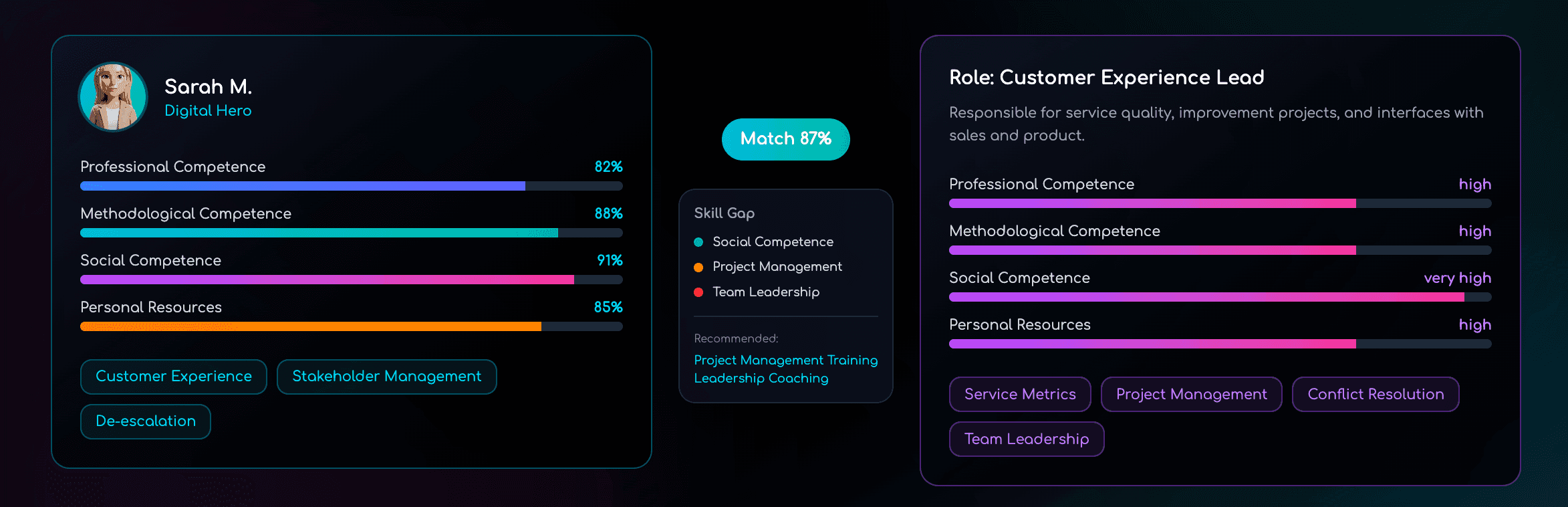
The AI in Lianova assigns these events to the four competence types and adds an archetype profile. The result is a hero profile that makes professional, methodological and social competencies plus personal resources visible in one coherent picture.
Role profiles as counterpart
These hero profiles are then connected with the organization’s role profiles. Tasks, responsibilities and required skills for a role are described in a structured way. This makes it transparent which combination of competencies is truly decisive in a function.
Matchmaking beyond simple skill gaps
On this basis Lianova enables skill based matchmaking. The system checks which digital heroes fit particularly well with a role, where their strengths lie and which gaps could be closed with reasonable development.
It is not about ticking off single skills, but about the interaction between competence types, work style and context. This is how talents become visible that would never show up in classic recruiting.
First steps towards a skill based organization
The path towards a skill based organization is not a big bang project. It starts with a few clear decisions and manageable steps.
Identify critical roles and value streams
First, it is worth looking at central roles and value streams. Where is the success of the organization decided today. Which work has to be done reliably there.
From these analyses, core competencies can be derived that will really matter in the coming years.
Define a competence model
In parallel, you need an agreed competence model that reflects the described competence types and fits the language and culture of the company. This model is the foundation for creating competence profiles, building skill inventories and sharpening role profiles. Without this foundation any skill initiative will remain fragmented.
Gradually align processes with skills
The third step is about integrating skills into existing processes. The goal is not to introduce yet another tool, but to gradually align recruiting, performance conversations, project staffing and learning offers with skills.
Each of these touchpoints produces new data that sharpens the picture of the organization. Lianova can accelerate this path because digital hero profiles, competence models and matching logic are already built into the platform.
Conclusion skills as new organizational logic
The question is not whether organizations will deal with skills, but how deliberately they do it. Those that continue to steer mainly via job titles, departments and job descriptions waste potential, increase pressure on recruiting and risk losing talent even though fitting work exists internally.
A skill based organization uses what is already there. It makes competencies visible, connects people based on their skills rather than just their positions and creates clear perspectives for development and career.
With digital hero profiles and skill based matchmaking, Lianova offers a practical way to bring this idea to life. In this way the fashionable phrase of the skill based organization becomes a concrete steering model that makes companies more resilient and gives people roles in which they can truly be effective.
FAQ
What is a skill based organization?
A skill based organization designs work and people decisions around skills instead of static job titles and positions. Tasks, value creation and competence profiles are the starting point. Roles, teams and structures are then aligned to these skills, which makes internal mobility, workforce planning and learning much more flexible.
How does a skill based organization differ from a classic role based structure?
In a classic structure, the position comes first and people are searched or moved to fit that position. In a skill based organization, the work that must be done comes first. The company asks which skills are needed, who already has them and who can grow into them. Org charts remain, but they are complemented by a transparent skill map that actually steers staffing and development.
Why are competence types important for working with skills?
Competence types create a shared language for skills. By distinguishing professional, methodological, social competencies and personal resources, organizations can describe skills clearly, compare profiles and define roles in a consistent way. This shared language is essential for clean competence mapping, skill management and fair internal staffing decisions.
How does Lianova support a skill based organization in practice?
Lianova builds digital heroes for each person by analysing life stories, work experiences and behaviour. The platform derives competencies in four areas, adds an archetype profile and connects these hero profiles with structured role profiles. On this basis, Lianova enables skill based matchmaking for internal recruiting, project staffing, team checks and skill gap analysis.
What are first steps towards becoming a skill based organization?
Useful first steps are to identify critical roles and value streams, define a competence model for the organization and then align core processes with skills. Workforce planning, internal recruiting, performance talks and learning should gradually be based on explicit skill data. A platform like Lianova accelerates this by providing ready made competence models, hero profiles and matching logic.
How does a skill based organization improve internal mobility and redeployment?
By making skills transparent across the workforce, a skill based organization sees who can take which role, project or task based on their real competence profile. Redeployment and internal moves are then guided by skill fit rather than gut feeling or titles. This reduces unnecessary external hiring, makes better use of internal talent and offers people real development options instead of only vertical career moves.